
Images from Grace Church today

I really did try to take a day off today. I also tried to stay away from the Square, and the Church, but I couldn’t resist coming down to see what was going on.

Some interesting images. First off, when we got there around 3:30, we saw workers unloading concrete barriers on West Washington Ave. It was surreal and evoked images of the security steps taken in the days after 9/11. It wasn’t at all clear what the barriers were for. Even after they were set up around the W. Wash. entrance to the Capitol, I couldn’t figure out why they were needed and what they were protecting.

Here’s a picture of them unloading the barriers:

Here’s a photo of the W. Washington entrance to the Capitol from the steps of Grace Church. Shortly after this was taken, the crowd here moved to the left, to the State Street entrance, on the theory that the noise they made could disrupt the Governor’s budget speech:
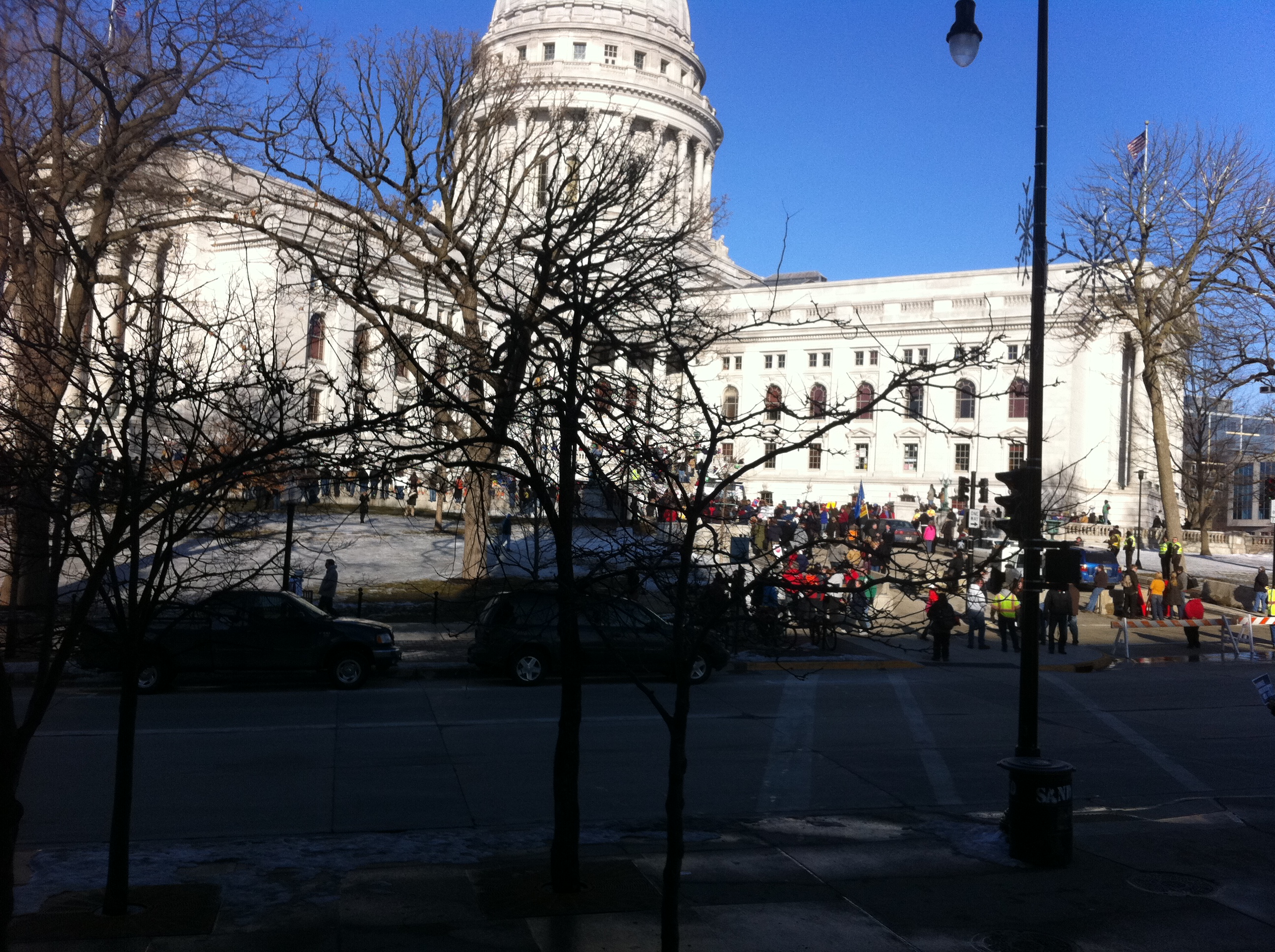
We went home after an hour or so, and passed another stark image. To get to our car, which was parked in the alley next to Grace Church, we had to pass through the line of guys waiting for the doors of the Men’s Drop-In Shelter to open so they could get a meal and a place to sleep for the night.

I had read about some of the cuts Governor Walker is proposing, and as I chatted with the guys in line, I wondered how many more people would end up on the street if the cuts went through, how many people would die because they couldn’t get access to health care or housing or mental health care.

Most of the protesters are union members–teachers, public service workers, police and firefighters. There were representatives from other unions as well. They have a great deal to lose, of course, but the stakes are even greater for the poor, the sick, the mentally ill, and the other marginalized members of society.

Peter Gomes, RIP

I woke up this morning to learn of the death of the Rev. Peter Gomes, whose official title at Harvard was “Plummer Professor of Christian Morals and Preacher to the University.” He suceeded George Buttrick in that position in the early 1970s. When I arrived at Harvard Divinity School in the early 1980s, Peter was already a fixture at Harvard. His weekly teas at Sparks House were a popular tradition and his sermons at Memorial Church were brilliant and beautifully-written.

Peter, along with New Testament Professor Helmut Koester, taught the course from which I gained the most for my ministerial practice, and on which I continue to draw. Entitled “Exegesis and Preaching,” the two picked the most challenging texts in the New Testament. We were assigned three of them. One week, we would have to write an exegesis paper that would pass muster with one of the greatest New Testament scholars of his generation. The next week we would write and deliver a sermon on that text. Each step was a lesson in humility, as well as in the interpretation of scripture and the proclamation of the Word.

Following the public delivery of the sermon, we would spend an hour in a one-on-one tutorial with Peter. That amount of time with a Harvard professor was unheard-of. I don’t think I got that much individual attention from a professor in a semester, even when I was writing my dissertation.

The tutorial was humiliating. We were to bring the manuscript to the tutorial. Peter would take it from our hands when we entered his office, we would sit down, then he would deliver it back to us; our pathetic words in his majestic voice. I remember the first session like it was yesterday. As I heard him read my text, I wanted the floor to open up and bury me. It was perhaps the most difficult moment of my entire academic career.

What an experience and how exhilarated I was when both he and Helmut praised my final work, passable exegesis on Revelation 21 and a decent sermon. Whatever my gifts and skills as a preacher, I owe them to that class and those two brilliant professors.

Peter was also quite funny. I still remember the story he told about communion wine. One of the students in class asked him about what wine he used for communion. Peter replied:

My predecessor, George Buttrick, always said that one should use nothing but the best domestic port for communion wine, and he deemed Taylor’s Tawny Port to be that wine.”

I always hoped to see a commercial for Taylor’s with Peter standing on the steps of Memorial Chapel, in full ministerial regalia, holding a bottle of Taylor’s Tawny Port in his hand, and saying those words.

In the 1980s, Peter was often vilified by progressive students at Harvard Divinity School for being a Republican. He gave the benediction at Reagan’s second inaugurals, preached at the National Cathedral in conjunction with George H. W. Bush’s inaugural. That all changed when he “came out” in the 1990s.