
Wisconsin and South Carolina

There are a couple of things going around the web that put my move in 2009 from Greenville, SC to Madison, WI in perspective. One of them is somewhat misleading, if memory serves me correctly.

The first is the map that shows states allowing collective bargaining as opposed to those that don’t.
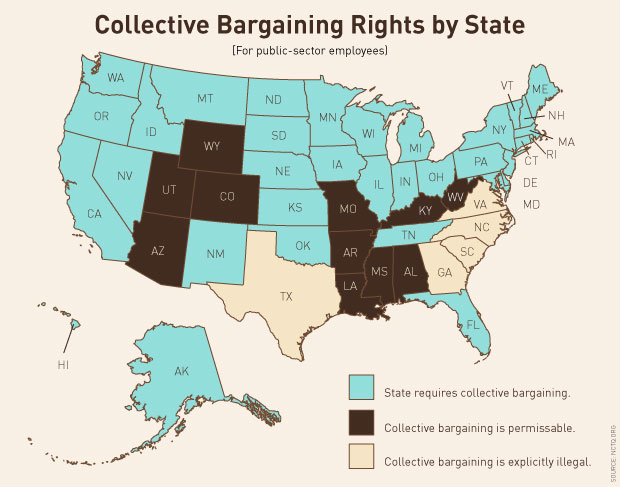
I’m grateful for the map because it confirmed what I had suspected. I recalled that there was some major conflict while we lived there when the state patrol attempted to organize, not even to begin a union, and were shut down.

The other is the statistic related to ACT/SAT scores which a number of sources have correlated to the collective bargaining map. It turns out, South Carolina ranks #50 on that list. This may be misleading because, if memory serves me correctly, the ACT is taken by all South Carolina High School students.

Whether or not the latter is true, what is true is that South Carolina schools are woefully underfunded and teachers underpaid. I was amazed to learn that universal public education didn’t exist in the state until the 1920s; that even then, transportation wasn’t provided. Much of that was due to racism and Jim Crow laws but it also reflected a different vision of the public good than that which was created in the old Northwest Territories by Thomas Jefferson, with the provision for a school in every township.

More surprising still was the revelation that as late as the early 1970s, school buses were driven, not by adults but by high school students who had demonstrated their maturity. Yes, that’s right (at least in Greenville County). I was sitting at a vestry dinner when I learned that. My jaw dropped. I was flabbergasted, but the Greenville County natives were shocked that I found this odd.

I know teachers and other public service workers in South Carolina who work incredibly hard for little pay and little respect. I also know that many of them struggle to make ends meet and struggle to maintain their self-respect. I am in awe of them. I am also in awe of all of those in Wisconsin and throughout the country who work hard to make our nation, our states, and our local communities better places.

One last thing. I can’t imagine protests like the ones taking place in Madison occurring in South Carolina. I remember all too well the vitriol which came about when Furman faculty members protested President Bush’s visit to commencement in 2008. But I hope that what is happening in Madison gives heart to public service workers across the country. You are patriots and we owe all of you a great deal.


A fascinating description of a recently discovered mosaic

G. W. Bowersock comments on a mosaic currently displayed at the Metropolitan Museum of Art. Discovered in Lod (ancient Lydda), the mosaic, dating from around 300 CE, depicts a number of animals, many of them exotic. Bowersock the mosaic as a whole in light of the image of a vase, with handles depicting panthers in the mosaic’s center. He argues it derives from the Dionysian cult, and that it is transmuted here in a Judeo-Christian context, with allusions to Isaiah’s prophecy of the peacable kingdom.

The full essay is here: The Lod Mosaic by G.W. Bowersock | NYRBlog | The New York Review of Books.

Nonviolence

Nonviolence has been very much in the news of late, with the uprisings in Tunisia and Egypt. The New York Times profiles one of the leading theorists of nonviolent direct action, Gene Sharp. I met Gene Sharp back in the 1980s when our non-violent efforts were directed at the proliferation of nuclear weapons and US actions in Central America. Nonviolence has been much on my mind this week, because of the gospel reading for this Sunday:

Jesus said, “You have heard that it was said, `An eye for an eye and a tooth for a tooth.’ But I say to you, Do not resist an evildoer. But if anyone strikes you on the right cheek, turn the other also; and if anyone wants to sue you and take your coat, give your cloak as well; and if anyone forces you to go one mile, go also the second mile. Give to everyone who begs from you, and do not refuse anyone who wants to borrow from you. (Matthew 5:38-42)

While it may seem on the surface that Jesus is advocating complete passivity, that is not the case. The Greek word translated here as “do not resist” could be translated more literally as “stand against.” The actions Jesus mentions, turning the other cheek, giving one’s cloak as well as coat, and going the second mile, are, as MLK and Gandhi pointed out, intended to transform the oppressor.

Here’s an interview with Gene Sharp, author of The Politics of Nonviolent Action. It focuses on events in Egypt and Tunisia, but is interesting in light of ongoing events here in Madison.

Here is the section of questions related to religion:

NS: While watching the coverage, many of us were struck by the images of Muslims and Christians protecting each other while praying. Do you think religion was a significant factor?

GS: Not from anything that I have found so far.

NS: Nonviolence and pacifism have often been historically associated with religions, like Jainism and Christian “peace churches”—

GS: Yes, that’s right.

NS: Is religion at all essential to motivating nonviolent movements, or can the ideas transcend their religious origins?

GS: It’s not even a question anymore. They have transcended religious boundaries. If people come from any particular religious group and are inspired to be nonviolent and to resist—not just to be nonviolent and passive—that’s fine. But don’t claim that they have to believe in a certain religion. Historically, for centuries and even millennia, that has not been true. Nonviolent struggle, as I understand it, is not based on what people believe. It’s what they do.

NS: But don’t cultural differences make some societies more likely to act nonviolently than others? Or is everybody equally equipped to do so, independently of their culture?

GS: Setting culture aside for the moment, not everybody is equally equipped to do anything. But when The Politics of Nonviolent Action was first published in 1973, the famous anthropologist Margaret Mead said in her review that what I was maintaining—without saying so, in so many words—was that this is a cross-cultural phenomenon.

NS: There have certainly been stereotypes suggesting that Muslims couldn’t do something like this, that they can only use violence.

GS: It’s utter nonsense. In the North-West Frontier Province of British India, the Muslim Pashtuns, who had a reputation for great violence, became even braver and more disciplined nonviolent soldiers than the Hindus, according to Gandhi. It’s a very important case. And when my essay “From Dictatorship to Democracy” was published in Indonesia, it carried an introduction by Abdurrahman Wahid, a Muslim leader who later became president.