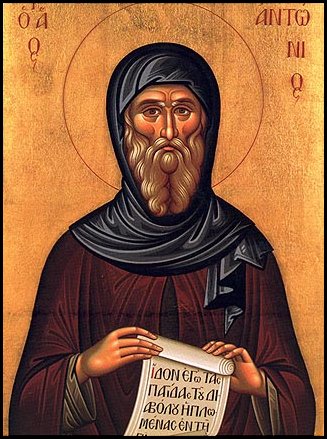
Today is the commemoration of Antony the Great in our liturgical calendar. Here’s a homily I prepared on him a couple of years ago:

Antony is one of those saints who has been a fixture in the liturgical calendar for centuries. And rightly so. Antony is one of the most important figures in the birth of monasticism. Antony lived in the third and fourth centuries. We’re not exactly sure of his dates, but the best guess is that he lived from 250 to 350 or thereabouts. He lived in Egypt, was the child of wealthy Christian parents, and after their death, while he was still a young man, he heard the gospel for today read and decided that was what he wanted to do. He put his sister in a convent, gave away his money, and went off into the desert to seek intimacy with God. Over the years, he moved further and further away from civilization, but wherever he went, he was pursued by curiosity seekers and by would-be disciples. Occasionally he would return to the city. We know that when he was a very old man, he went to Alexandria, which was the Egyptian metropolis, and the leading center of Christianity in the region, at least twice, and conferred there with bishops.
The flight from the city into the wilderness was not unique to Christianity in Antony’s day. Wealthy people had begun to abandon the city for the countryside, where they could live in leisurely quiet. Poor people fled the city to seek food, shelter, and protection. What set monasticism apart was the certainty that the city was an evil place, that the wilderness was more suited to the pursuit of God.
This tension between city and wilderness is deeply ingrained in our own culture and in the cultures that gave rise to the biblical writings. It’s been a very long time since we in America saw urban life as the ideal.. We may not prefer the wilderness to the city, but we certainly tend to distrust the city, and all that it represents. Longer ago, the distrust of the city and even the town ran much deeper. When I was a boy, my mother read the books of Laura Ingalls Wilder to my sisters and me. If you remember them, you remember that Pa was always on the move further west, further into the wilderness; as soon as he could see the smoke from a neighbor’s chimney, he was ready to find somewhere new to live.
Antony did much the same, and indeed throughout the Middle Ages, monks settled in the wilderness, in places as remote as possible. There’s something of an irony here, however, for wherever monks went, laypeople quickly followed them. Antony’s biographer, Athanasius, said of Antony that “he made the desert a city.” By that he meant two things; first: Antony and the monastic ideal were so popular that perhaps thousands followed him into the desert; second, that in their communities, the monks created a new kind of city, focused on the worship of God.
The wilderness also plays a role in the story of Jesus. Jesus was baptized by John, who lived in the wilderness, dressed in camel’s hair, and ate locusts and wild honey. People came out into the wilderness to see him. He seems to have been something of a curiosity, but the encounter with John changed people’s lives. In the weeks to come, we will hear of Jesus’ own journey into the wilderness, where he will be tempted by Satan.That encounter with Satan in the wilderness seems to be a turning point. It comes immediately after his baptism, and after the baptism, Jesus returns to Galilee and begins his public ministry.
Usually when we think of the image of wilderness, we think of wasteland, of danger and violence. In the language of spirituality or religious life, the wilderness is often used as a metaphor for a period of intense struggle, or perhaps a feeling of alienation from God. For Antony and the other Egyptian monks, the wilderness or desert was not a place of alienation from God. Rather, it was a place that enabled intimacy with God. Stripped bare of everything but the essentials, the monk could focus only on what really mattered—his or her relationship with God.
Compared to Antony, of course, our lives are much more complex. The idea of throwing it all away for the opportunity to focus on one’s relationship with God may seem appealing occasionally, but few of us would ever act on that impulse. We all have those times in our lives when it seems as if we are in a desert, when the old way of doing things, our lives and lifestyles, seem difficult or meaningless. Sometimes, in those deserts, we seem to be all alone, abandoned even by God. That feeling of abandonment was not foreign even to those monks and nuns of the early centuries of Christianity. They left behind stories of their struggles with temptations and their struggles to deepen their relationships with God. Antony’s example reminds us that even there, in the wilderness, God is present.
Antony’s life and lifestyle may seem completely alien, perhaps even bizarre to us. Few of us would ever contemplate, at least for more than a moment, throwing everything away in our pursuit of God. That’s exactly what he did, and we might wonder about the impact of that decision on those around him—on his sister who he put in a convent. But his example is also a lesson that we respond to the call of God in very different ways. Today’s gospel led Antony into the wilderness. The very same words of Jesus, nearly 1000 years later, spurred St. Francis to begin a very different form of the religious life, focused on poverty, on preaching, and reaching out to those in need. The question for us is how do we respond, authentically and passionately, to the call of Jesus today?

 Preaching Grace on the Square