A Sermon for the Fourth Sunday after the Epiphany, Year A

The Foolishness of the Cross
Fourth Sunday after Epiphany
January 30, 2011

I love to bless stuff! I’ve made something of a joke of it over the years. I’ll bless anything. In part, that’s because of the priests I’ve worked with, one of whom always seemed to have an aspergillum near to hand. Aspergillum—if that word is unfamiliar to you, think of it as a “holy water pot.” Around here, I’ve blessed the new freezers and coolers in the food pantry, the youth room space, animals of course, on St. Francis’ Day, and most recently the new dishwasher.

For some, such stuff smacks of superstition or silliness, but it’s not, or only sometimes, and on the surface. Blessing is important, even the blessing of inanimate objects reminds us that they are set aside often, for important uses. Blessing is not a ritual cleaning, or a magical act. To bless things, whether it’s a dishwasher, a dog, or the food before we begin eating, underscore the sacred nature of all of creation and that even ordinary things can be set aside for holy use. Continue reading

Vision: From the Life of Hildegard of Bingen

I was intrigued last fall when I read the NY Times review of this film by Margarethe von Trotta so we went as soon as we found out it was playing in Madison. Hildegard is a fascinating character–a Benedictine abbess who had visions, wrote music, visionary works, as well as books on healing and nature. The film is by one of Germany’s most important directors. It’s not a great film, by any means, but for the most part it comes across as a fairly decent historical depiction of Hildegard. The film does a good job of showing the interplay of religion, politics, and family ties, and also highlights the patriarchy of the Middle Ages and of the medieval Church. At times, it seems to be something of a catalog of Hildegard’s activities, moving from scenes showing her instructing her nuns on the healing powers of herbs, to composing music, to writing. The visions are a constant and von Trotta also subtly raises questions about the relationship between Hildegard’s physical ailments and her religious experiences. She also hints that Hildegard may have used faked illness to get her way.

It’s definitely worth seeing if you are interested in medieval history or German cinema, but if you’re looking for action and excitement, the most you’ll get are a few scenes of monks and nuns flagellating themselves, a practice Hildegard criticized.

The Anglican Communion’s “consistent condemnation” of anti-gay violence

David Kato, a prominent Ugandan Gay Rights activist, was brutally murdered this week. While police officials chalked the motive up to robbery, most observers suspect his death was the result of the ratcheting up of anti-gay rhetoric and violence in Uganda in the last few years, much of it spurred on by American evangelicals.

Kato’s death came as the Primates of the Anglican Communion are meeting. The meeting is smaller than usual with a number of national church leaders staying away, some because of the Episcopal Church’s openness to gay and lesbians. In the course of the meeting, Presiding Bishop Katharine Jefforts Schori released this statement:

At this morning’s Eucharist at the Primates Meeting, I offered prayers for the repose of the soul of David Kato. His murder deprives his people of a significant and effective voice, and we pray that the world may learn from his gentle and quiet witness, and begin to receive a heart of flesh in place of a heart of stone. May he rest in peace, and may his work continue to bring justice and dignity for all God’s children.

The Archbishop of Canterbury released a statement of his own this morning, two days after Kato’s death. It reads:

“The brutal murder of David Kato Kisule, a gay human rights activist, is profoundly shocking. Our prayers and deep sympathy go out for his family and friends – and for all who live in fear for their lives. Whatever the precise circumstances of his death, which have yet to be determined, we know that David Kato Kisule lived under the threat of violence and death. No one should have to live in such fear because of the bigotry of others. Such violence has been consistently condemned by the Anglican Communion worldwide. This event also makes it all the more urgent for the British Government to secure the safety of LGBT asylum seekers in the UK. This is a moment to take very serious stock and to address those attitudes of mind which endanger the lives of men and women belonging to sexual minorities.”

The ABC says violence against gays “has been consistently condemned by the Anglican Communion worldwide.”

Later today, we learned that violence broke out at Kato’s funeral. The BBC reports that the priest presiding said from the pulpit:

“You must repent. Even the animals know the difference between a male and a female,” he said, before warning that they would face the fate of residents in Sodom and Gomorrah, the biblical cities destroyed by God.

Gay rights activists then stormed the pulpit and prevented the priest from continuing.

An excommunicated priest who has in the past called for people to respect the rights of homosexuals then presided over the rest of the service.

Apparently, some Anglicans worldwide haven’t received the message sent “consistently by the Anglican Communion.”

Making Meaning out of Mayhem

It’s been a few weeks since the tragedy in Tucson and the initial frenzy to place blame has given way to some more sober reflection and thoughtful attempts to place the events that Saturday in a larger context.

I came across this essay today by Rochelle Gurstein. Riffing off of the coincidence that Christina Green was born on 9/11, Gurstein puzzles over various attempts to make sense of it all.

The horrific mass shooting, I am supposed to tell myself, was nothing more than the act of a lunatic, signifying nothing, utterly absurd. And this is how Representative Giffords’s forum with its homey name, “Congress on Your Corner,” that terror-filled Saturday morning is starting to feel, now that providence, fate, and finally, cause-and-effect relationships have lost their powers of elucidation. All we are left with is the standard, all-service, therapeutic explanation of mental illness…

Gurstein resists the attempts to make some connection between the coincidence of Christina’s birth, observing that had she grown up and gone into politics, that might have provided an context or explanation for her life choices. She also is critical of efforts on left and right to connect the events in Tucson with political rhetoric or violence in the media. At the end of the article, she even opposes the desire of Christina’s father to grasp some larger meaning from the donation of her organs.

Gurstein’s ruminations are challenging, especially in light of the universal human effort to make meaning out of life and out of events. And it offers an interesting perspective from which to examine another exchange, this one between Mark Ralls and Melinda Hellenberg. Hellenberg, writing in Politics Daily, argues that Christians should not label mental illness as evil:

Yet it’s the Christian underpinnings of my view of evil, in a world in which we do have free will, and sin, which in all cases involves a choice, that makes it impossible for me to ever see those who suffer from schizophrenia as an embodiment of moral evil. We don’t know for sure that Loughner has schizophrenia, though his paranoia and references to “mind control” are classic markers. But those who are so afflicted haven’t chosen their delusions and hallucinations; a stand-out even in the pantheon of dreadful diseases, theirs is an illness no one would choose.

I found her analysis somehow wrong, but couldn’t put my finger on it. Then I read Mark Ralls. Building on the Augustinian notion of evil as a privation of the good, Ralls articulates the conception of evil as a “tear in the fabric of creation.” He goes on to point out that in Loughner’s fascination with nihilism. Then he shifts to an observation about our culture’s embrace of nothingness:

Consider something as silly – and seemingly harmless — as “Reality TV.” Shows like “The Jersey Shore” not only make light of terrible life choices. They glorify the wasted life. They propagate the cultural myth that our lives lack purpose. As Christians fail to counter this myth with prophetic utterance and interceding prayer, we are complicit in the cultivation of troubled young hearts and minds.

With Ralls, I agree that naming evil is among the most important tasks of Christian theologians and communities; to name it, not only in the choices of individuals, but in structures and institutions like inadequate mental health. He concludes:

Melinda Henneberger is right. We must not personify evil and casually ascribe it to someone else. Yet Barack Obama is more right. We must dare to speak of evil when we encounter it. Otherwise, we have no chance of recognizing it when it comes to “sleep in our bed, to eat at our table.”

Reading the three essays together is an instructive lesson in theodicy.

Incomprehensible Theology

Michael Jinkins challenges the “dumbing-down of theology, taking off from the following research:

Last fall “The Economist” reported on new research by Daniel Oppenheimer, a Princeton University psychologist, which suggests that if you want people to learn something “make the text conveying the information harder to read.” “The Economist” comments that one of the perennial paradoxes of education “is that presenting information in a way that looks easy to learn often has the opposite effect. Numerous studies have demonstrated that when people are forced to think hard about what they are shown they remember it better.”

Money quote:

This is the great adventure of theological education. I’m talking about the kind of theological education we do in our congregations, in Sunday schools, and in our homes, and not only the kind we do in graduate theological schools. It invites us to comprehend that which cannot be comprehended, to interrogate that which provokes ever new questions, to engage with our whole hearts and minds the God who created us out of nothing, though of course we have no real conception of what it means to say “out of nothing.” There’s no way to appreciate the fact that God numbers every hair on our heads without appreciating the endless expanse of a universe that is a Tinker Toy to God.

It kind of reminds of one of the greatest compliments paid me by a student (though I doubt she meant it that way): “Dr. Grieser, your class makes my head hurt. I have to think too hard.” And that was at the end of an hour of Intro to Biblical Literature.

Anglican Eyes looking in the wrong direction?

There will be a lot of press in the coming days about the Primates Meeting in Dublin this week. Already there have been articles about which primates will attend and which won’t be there. Thinking Anglicans has the rundown. But perhaps this is better commentary: Google “bonobos” if you don’t get the reference.

Meanwhile work gets done even in Episcopal dioceses. A telling commentary from Julie Ingersoll on Religion Dispatches. Of course, there is pain. The article mentions those who went their separate way in the past decade. But the issue was never going to be resolve. There would always be contention, and in the midst of that contention, precious little good news gets proclaimed. We have gone our separate ways. Let’s get on with doing the Lord’s work in our own contexts and with our own perspectives. Perhaps the Primates are willing to do the same.

God chose what is weak in the world

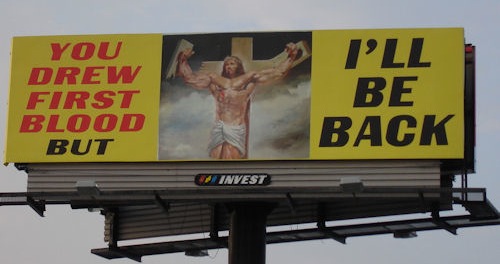
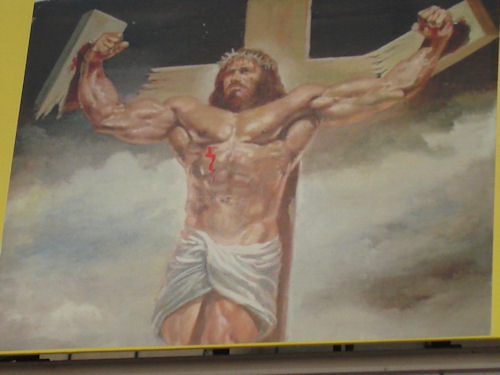
These images have been floating around on my desktop for a couple of months. It seems appropriate to post them now as an example of how Christians misinterpret the cross, in light of this week’s reading from I Corinthians. Here’s a billboard:

And a close-up:

Here’s Paul:

“For Jews demand signs and Greeks desire wisdom, but we proclaim Christ crucified, a stumbling block to Jews and foolishness to Gentiles, but to those who are the called, both Jews and Greeks, Christ the power of God and the wisdom of God. For God’s foolishness is wiser than human wisdom, and God’s weakness is stronger than human strength.
Consider your own call, brothers and sisters: not many of you were wise by human standards, not many were powerful, not many were of noble birth. But God chose what is foolish in the world to shame the wise; God chose what is weak in the world to shame the strong; God chose what is low and despised in the world, things that are not, to reduce to nothing things that are, so that no one might boast in the presence of God. He is the source of your life in Christ Jesus, who became for us wisdom from God, and righteousness and sanctification and redemption, in order that, as it is written, “Let the one who boasts, boast in the Lord.”

Nothing in that image of a God who is weak, is there?

New perspectives on the Atonement

I was interested to observe that during the Trinity Institute, both in the televised conversations, and in our discussions at Luther Memorial, the Atonement came under close scrutiny. Ben Myers points to Bruce McCormack’s 2011 Croall Lectures which set out a new typology of the Atonement. There’s reporting, with theological reflection here. When people ask me about the Atonement, and I’m always surprised when they do, I refer them to Gustav Aulen’s Christus Victor. I read it for the first time as an undergraduate; came back to it when I was preparing a course on the Theological Anthropology in the Christian Tradition. On second reading, I found it both interesting and troubling. I didn’t find it particularly helpful in understanding the perspectives of thinkers, either ancient, medieval, or early modern. That’s always the problem with typologies of course. Perhaps McCormack’s alternative will be more compelling, intellectually and theologically.

But what fascinates me most, as a theologian and as a pastor, is the continuing power of Atonement theory. Christians and seekers both struggle with the meaning of the cross for their lives. That came out in our conversations this week; I also encounter it in conversations with thoughtful parishioners. We still have work to do.


“Come, follow me” A Sermon for the Third Sunday after Epiphany

This past Thursday and Friday, I participated in the Trinity Institute Conference via a webcast at Luther Memorial Church. The topic was “Reading Scripture through other Eyes” and it brought together scholars from North America and Africa to explore the interpretation of scripture in various contexts. The conversations among the scholars were fascinating as were the discussions we had at Luther Memorial. I was struck once again by the centrality and importance of Christians wrestling together to understand scripture, and how Christians in different cultural contexts approach and learn scripture in different ways. Continue reading

Open Communion again

Or “Communion without Baptism.” A cogent three-part article by Derek Olsen that argues against the new custom on historical and theological grounds. I’ve talked about this before, but I agree with him that this practice constitutes so significant a change, that it needs careful and convincing theological formulation.

Part I

Part II

Part III

The comments are worth reading as well, because they offer insight into the depth of the disagreement and some of the strongest counter-arguments.