Some poetry for Tuesday in the Third Week of Advent

First, from The Guardian comes an article by Carol Rumens on David Wheatley’s “St. Brenhilda on Sula Sgeir.”

Then, Robert Pinsky on sonnets by John Donne and Gerard Manley Hopkins that refer to Jeremiah 12:1: “Righteous art thou, O Lord, when I plead with thee: yet let me talk with thee of thy judgments: Wherefore doth the way of the wicked prosper? wherefore are all they happy that deal very treacherously?” (KJV).

Donne concludes his sonnet with an image of a forgetful God. It’s a notion I’ve been coming back to often in the past few months. It definitely challenges common assumptions about God, but is of great consolation, too.

Waiting for God: A Sermon for the Third Sunday in Advent, Year A

Grace Episcopal Church

December 12, 2010

Today’s readings

There’s one of those British comedies that is often re-run incessantly on Public Television called “Waiting for God.” Set in what we would call a retirement community, it tells the stories of the antics of several irascible elderly people who fight against the community’s administration, their fellow residents, and injustice in their small town. The humor relies on the indomitable spirit of characters caught in situations over which they have no control. The title says it all. “Waiting for God” implies that their lives are over and they are only passing the time until they die.

Waiting for God may be a metaphor for people nearing the end of their lives, but it is also an appropriate image for the Season of Advent. We are waiting for the coming of Christ, and as we wait, we prepare in all kinds of ways for that coming.

In today’s gospel, we encounter John the Baptist, who like those characters in the sit-com, is waiting for the end of his life. Imprisoned by Herod, he must know that he will soon be executed. But he is waiting for God in another way. Having proclaimed the coming of the Reign of God, and the coming of the Messiah, John must be wondering whether his message was the correct one, whether he should be waiting for God.

Today’s gospel reading is one of the most interesting in all of Matthew. In the middle of the gospel of Matthew, Jesus is confronted by several of John the Baptizer’s disciples. John has sent them to Jesus to ask a question: “Are you the one who is to come, or are we to wait for another?”

Matthew puts this episode at in interesting point in his gospel. It’s one of those places where we see the gospel writer at work, very carefully shaping his image of Jesus. In Mark’s gospel, Jesus’ public ministry begins with a series of healings and miracles. While Mark provides a summary of Jesus’ preaching message, he does not give any detail, or show Jesus teaching in his first chapter. By contrast, Matthew moves directly from Jesus’ baptism and temptation in the wilderness to Jesus’ preaching. The first public event of Jesus’ ministry is the Sermon on the Mount which extends from chapters 5 through 7. Only after that, does Matthew show Jesus healing people.

These healings are very carefully constructed as well. There are three sets of three in chapters eight and nine. First, Jesus heals a leper, the centurion’s servant, then Peter’s mother-in-law. Then he crosses the lake, where he stills the storm, casts out a demon and heals a paralyzed person. After calling Matthew, there are three more healings. Jesus raises a girl from the dead, restores sight to two blind men, and gives speech to someone who is mute.

Only then do John’s disciples come with their question: “Are you the one who is to come, or are we to wait for another?”

It’s a puzzling, even surprising question. After all, if anyone should know that Jesus is the Messiah, it ought to be John the Baptizer. According to the gospel of Luke, John and Jesus are cousins, nearly the same age, John is six months older than Jesus. So like any good cousins, they had to have played together as children. Probably, since John’s parents were so old at his birth, they probably even shipped him off to Joseph and Mary during school vacations and summers so they could get some much needed rest.

Then, of course, he baptized Jesus, and according to the Gospel of Matthew, identified him as the Messiah, he saw the dove and heard the voice from heaven announcing, “This is my beloved son.” So how is it that after all of that, John still wonders whether Jesus is the one who is to come? If anyone ought to know who Jesus is, if anyone ought to know that Jesus is the Messiah, surely it’s John the Baptizer. Nonetheless, it is he who poses the question of Jesus, “Are you the one who is to come, or are we to wait for another?”

This little episode, hardly noticeable in the gospel accounts is very revealing. In spite of everything John the Baptizer knows, he retains some uncertainty. And in spite of everything John the Baptizer should know, Jesus addresses John’s questions directly. He does not ridicule his uncertainty, he does not respond as he so often responds to those who misunderstand him or misinterpret him. He does not say, “Oh ye of little faith!” No he answers the question directly: “Go and tell John what you hear and see: the blind receive their sight, the lame walk, the lepers are cleansed, the deaf hear, the dead are raised, and the poor have good news brought to them.”

In other words, Jesus clearly answers the question and relates it back to the prophecies in Isaiah that we heard in today’s first lesson, and also in the word’s of today’s Psalm: the lame walk, the deaf hear, the blind see. There’s something about the way in which Jesus answers the question that is important. Note his language: the lame walk, the deaf hear, the blind see. He is not emphasizing his own role in these miracles. Instead, Jesus emphasizes what has been done. It is as if he points away from himself, toward God, toward God’s powerful presence in the world through him. By acknowledging that the lame walk, the blind receive their sight, and deaf hear, we, and John, recognize the presence of God in our midst.

But it’s not enough. It’s not enough for John, and it’s not enough for us. There’s another image in today’s readings that I find of great help. In today’s epistle reading, we are reminded to be patient, to wait the coming of the Lord. As a farmer or gardener must wait for the crops they planted to bear fruit, so too are we told to be patient.

Of course patience is a hard thing to come by at any time of the year, but it may be most difficult in the season of Advent. We all know how eager children are for Christmas. We adults may be equally eager, if only to get it all over with. But there is more to it. In the midst of the hectic pace of Christmas, the shopping, the parties, the planning, we come to church and hear the simple words of the letter of James: “Be patient, therefore, beloved, until the coming of the Lord. The farmer waits for the precious crop from the earth, being patient with it until it receives the early and the late rains. You also must be patient. Strengthen your hearts, for the coming of the Lord is near.”

It’s a message that is important to hear, and not only during Advent. To wait for God is a very difficult thing to do. It means to allow God to act in the way, and when God wants to act, to allow God to answer our questions, to answer our prayers, in the fashion and at the pace that is God’s time, not ours. The letter of James was written at a time when early Christians were asking the question why the Second Coming hadn’t taken place; that delay was enough to challenge the faith of many. We see John the Baptizer in something of the same position in today’s gospel. For some reason, Jesus’ actions, his ministry did not quite fit the expectations John had of it. So he began to wonder, is Jesus really the Messiah, or should we wait for another?

To wait for God means also to open oneself up to the presence of God. God is here, in the world, God is present in our lives, yet too often we fail to see God’s presence, we fail to sense it. We don’t take the time we need, we don’t take the time that God needs to make that presence real.

But it’s also easy to mistake the presence of God for something else. John had a set of expectations about what the Messiah would be and do. And apparently, those expectations were not met by Jesus’ actions or teachings. The disconnect between the two led to his uncertainty. The same is true for us. There is a cacophony of voices around us in the world, laying claim to being the authentic voice of Christianity and of Christmas. There are shouts that Christians are persecuted in contemporary secular culture, that we have abandoned the truth of the faith in favor of being politically correct.

As Advent moves toward Christmas, as the pace of holiday activity increases, I pray that all of us find time in our daily lives to wait for God, to listen for God’s presence, to look for the signs of God’s coming in our midst. But most importantly, let us allow God to come to us in the fashion and manner, and at the speed, God chooses.

 

Karl Barth, December 10

I was surprised by the appearance in Holy Women, Holy Men of a commemoration of Karl Barth. Not that he isn’t important, mind you. No, what took me aback was his presence in a volume produced by politically-correct Episcopalians in the twenty-first century. I would be curious to know about his presence in the syllabi of theology courses offered at Episcopal seminaries.

Barth was an important stage on my own theological journey. I read the Commentary on Romans as an undergraduate, then worked through the German original of the second edition. His insistence on the utter transcendence of God and the centrality of Christ were revelations to me and helped me move away from the theology of my upbringing. His resolute opposition to Hitler and his sharp criticism of his teachers and 19th century liberal theology were helpful as well.

Thinking about Barth today reminded me of how far I have come theologically in the last thirty years. I don’t know that I’ve read anything of his since the very early 80s. Certainly at Harvard in that era Barth was mostly a foil for critique, almost a straw man. We were certain we had moved beyond him.

The write-up on Barth for Holy Women, Holy Men provides a standard biography and some sense of Barth’s place in twentieth-century theology. It makes no mention of his impact on Anglican theology and I suspect for most Anglicans with advanced training, their indebtedness to Barth is relatively slight. He was a Calvinist after all, and although he had a deep Incarnational theology, he was also convinced that there was a chasm between God and God’s creation. This meant that he was suspicious of reason. To put it in more positive terms; for Barth, the Word of God was the only certain knowledge.


Why I love the Daily Office: Psalm 39 edition

How often have I read or recited Psalm 39 over the years? For some reason this evening, while saying Evening Prayer, the words of Psalm 39 jumped out at me:

1 I said, “I will keep watch upon my ways, *
so that I do not offend with my tongue.

The opening verses are striking in tone, but it was the last verses that really threw me:

13 Hear my prayer, O LORD,
and give ear to my cry; *
hold not your peace at my tears.
14 For I am but a sojourner with you, *
a wayfarer, as all my forebears were.
15 Turn your gaze from me, that I may be glad again, *
before I go my way and am no more.

Verse 13 is clearly a plea to God to attend to the Psalmist’s cries, but what’s going on with verses 14 and 15? On the surface, v. 14 seems to be self-deprecating, but v. 15 is a plea for God to ignore the Psalmist–apparently God’s gaze is oppressive–until the Psalmist’s death.

What profound and unsettling notions of God and human being are packed into those two verses!

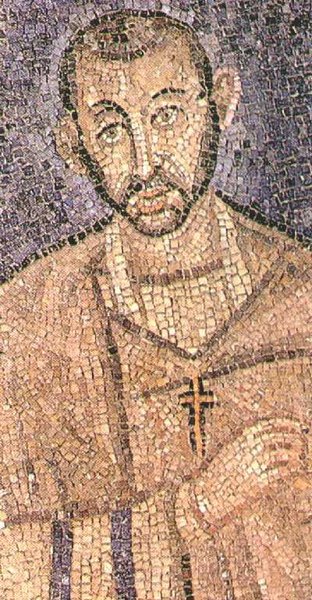
Ambrose of Milan, December 7

Today is the commemoration of Ambrose of Milan, one of the great Fathers of the Church. After a successful career in the Imperial Administration, Ambrose, according to legend was acclaimed bishop of Milan by the mob. He was a fierce defender of Nicene orthodoxy against the Arians and did battle against emperors, most notably forcing Theodosius to do public penance for the massacre of several thousand people in Salonika. He is credited with introducing hymnody into the western Church.

Augustine writes of him in Confessions:

And so I came to Milan to Ambrose the bishop, known throughout the world as among the best of men, devout in your worship… I used enthusiastically to listen to him preaching to the people … I hung on his diction in rapt attention … my pleasure was in the charm of his language…. (V.xiii.23)

Ambrose’s preaching and exegesis contributed to Augustine’s intellectual conversion (as a young man he had found Manichaean theology more convincing than Christian scripture):

I was also pleased that when the old writings of the Law and the Prophets came before me, they were no longer read with an eye to which they had previously looked absurd, … And I was delighted to hear Ambrose in his sermons to the people saying, as if he were most carefully enunciating a principle of exegesis: ‘The letter kills, the spirit gives life’ (II Cor. 3:6) Those texts which, taken literally, seemed to contain perverse teaching he would expound spiritually, removing the mystical veil. (VI.iv.5)

In Confessions, Augustine quotes Ambrose’s hymn Deus creator omnium several times:

GOD that all things didst create
and the heavens doth regulate,
Who doth clothe the day with light,
and with gracious sleep the night….

And we will sing another on Sunday during our Festival of Lessons and Carols, Veni Redemptor gentium (Redeemer of the nations, come).


Now that’s a St. Nicholas Day celebration!

On the first Monday of each month, Grace Church provides a meal to the guests who stay in the Men’s Drop-In Shelter, and to anyone else who might want to join us.

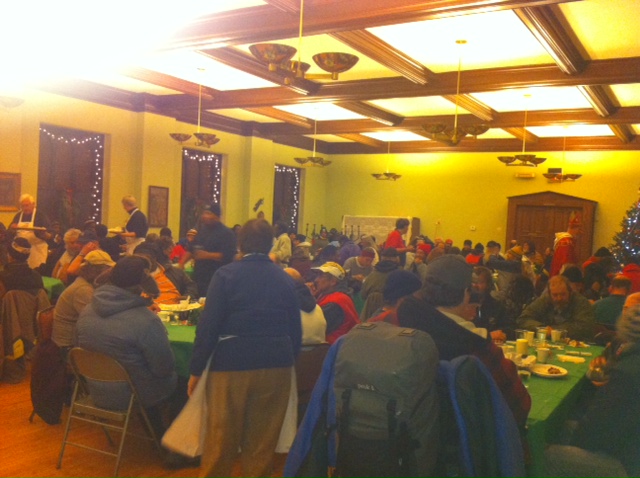
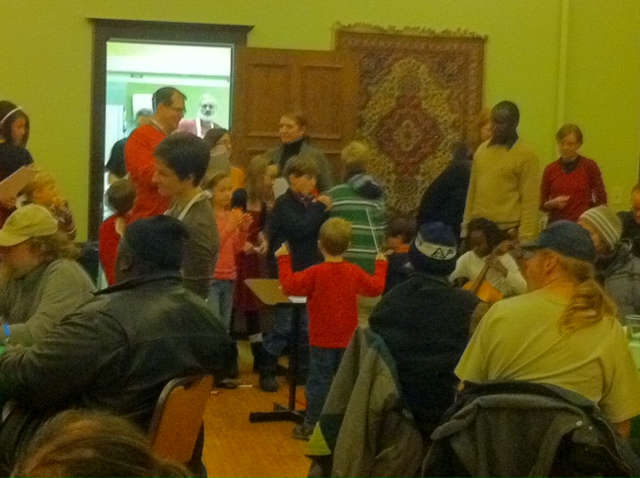
Today is St. Nicholas Day, so we decided to use that as our theme. The Guild Hall was decorated for the holidays, complete with Christmas tree (all thanks to the hard work of Ginny Shannon and her crew); members from our choir sang, as did our kids. The menu was ham, potatoes gratin, green beans, and lots of Christmas cookies. We collected socks and gave a couple hundred pairs away to our appreciative guests.

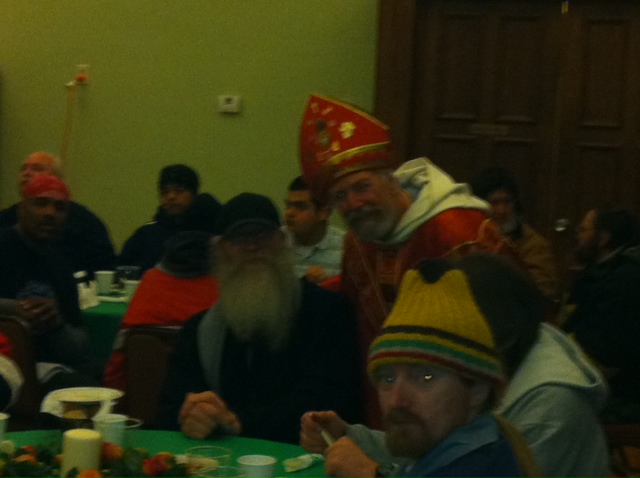
St. Nicholas Day needs an appearance from the bishop himself, so he came to pass out chocolate and socks.

A few pictures from the gala:

Here’s St. Nick, comparing beards:

Here’s a shot of Guild Hall:

Here are the kids with their kazoos:


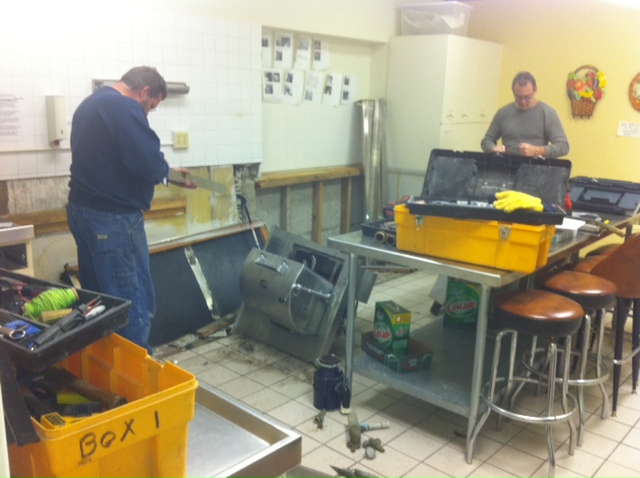
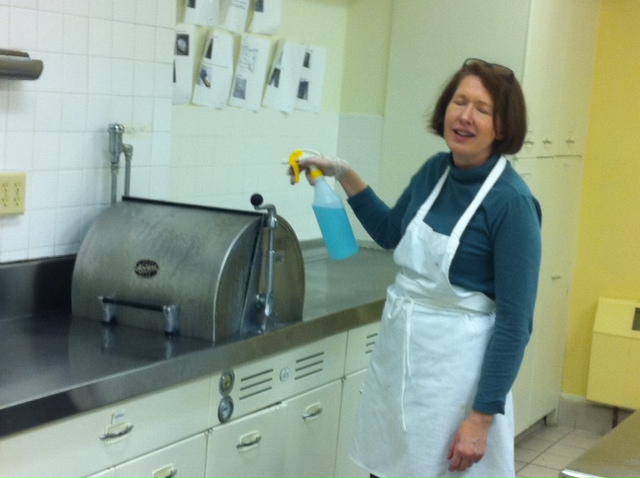
And tonight may have been the final performance of our 50-year old Hobart dishwasher. The last time we tried to get it repaired, when the guy called in for parts, the home office had to search for the parts book in their archives. We hope to have a new one installed by our next shelter meal on January 3.

Thanks to everyone who helped with the meal tonight: the volunteers, the cooks Wolfgang and Christian, the shelter meal committee, and to all those who helped preparing food and cookies in advance, and the Rector’s Guild, who donated money toward the holiday ham.

Advent II

December 5, 2010

“May the God of hope fill you with all joy and peace in believing, so that you may abound in hope by the power of the Holy Spirit”

Sometimes, I think Advent suffers from bi-polar disorder. The lesson from Paul’s letter to the Romans ended with those words, but in the Gospel, we heard words from John the Baptizer that promised doom and destruction, fire from heaven.

What are you hoping for? What is your deepest desire, your greatest wish? Advent is a season of hope as we look forward to Christmas. Children are hoping for a big haul under the Christmas tree. Some of us are hoping for other things—that the pain we live with will go away; that we will have enough money to make it through the month; that the relationship with our spouse or partner will pass through the rough patch and find more stable footing. Are your hopes only about yourself and your family? Do you harbor hope for Grace Church, for this community, our nation and the world? Or are those things just too much to ask for in our time, with a difficult economy and a poisonous political culture?

Paul’s hope encompassed all of those things. His expression of hope comes at the end of a passage that began with him pleading to his readers to be at harmony with one another, and moved from the immediate community to Christ’s work of reconciling human communities with one another—Jew and Gentile, and with God.

Paul stresses that the community, the church, is the primary place for hope, and for the expression of reconciled community in chapter 16. He does it explicitly by naming individuals in the church at Rome, 26 of them. They encompass the diversity in society and the church. There are rich and poor, slave and free—we know that there were some Roman Christians who voluntarily sold themselves into slavery in order to provide for the needy in the congregation. He also named women who were leaders in that community; indeed, he named one woman Junia, who was an apostle.

Paul’s vision of this new community came up against the reality of human nature. He was writing to a church at Rome with which he had no direct connection. In fact, many scholars believe that he conceived the letter to the Romans as something of a letter of introduction. Paul would be coming to Rome, and wrote this to let the church in Rome know who he was and what he was about. But Paul knew well the reality of people living together. He himself experienced bitter conflict with churches that he had founded, in Corinth for example. But that conflict did not temper his faith in God. Nor did it shake his belief that the church was the body of Christ, and his hope for the church and for the world. He believed strongly that God was at work in the world, making all things new.

Contrast that vision of a hopeful future with today’s gospel. The second Sunday of Advent is always dedicated to John the Baptist, that enigmatic figure who in all four gospels is linked to Jesus, but whose depiction in each of the gospels raises questions about who he was and about his relationship to Jesus. John is clearly depicted as the last of the prophets, one pointing forward to the coming of the Messiah. By describing him clad in camel’s hair and a leather belt, Matthew places him in the line of Hebrew prophets that stretches back to Elijah and Elisha.

He seems to be something of a celebrity, or at least a figure of curiosity, someone people might check out as they do today. The crowds come to see him, and he preaches to them the coming of the Kingdom of Heaven, and calls for them to repent of their sins in preparation for its arrival. Eventually, even the members of the leading Jewish groups—the Pharisees and the Sadducees come to see what the fuss is all about. His message to them is somewhat different, much more threatening: He calls them a brood of vipers and warns that fire from heaven will come down to destroy them.

I’ve always suspected that John spoke those words of condemnation with at least a little glee. Here he was, out in the desert, preaching and baptizing, sensing with immediacy a coming change, a cataclysmic intervention of God in history. He preached against the comfortable, the wealthy, and the powerful. And now, they were coming out to hear him, too. The kingdom of heaven may have been at hand, but like so many other prophets of disaster, John may also have been looking forward to seeing the destruction of his enemies.

The gospels agree that there was more to his message than gloom and doom. Whether historically accurate or not, the gospels all have John proclaiming the coming of the Messiah, the coming of the man who the gospel writers, and we, believe to be the Christ, the Savior of the World. Matthew has him proclaiming Jesus’ coming with the same certainty that he had about the coming of the Kingdom of Heaven, and the descent of divine fire upon God’s enemies.

What I find most interesting is that despite the certainty we see here, at the end of the day, John was not certain at all. Later in the gospel, after he’s been arrested by Herod, John sends some of his disciples to Jesus, to ask of him whether indeed he was the one they were waiting for, or whether they needed to continue to wait, and hope. He died without knowing whether the one he hoped for had come. He died in uncertainty. Did he have hope?

In today’s readings, we have two images of hope. Isaiah paints a picture of a world in which there is no anger, enmity, or violence, where natural enemies play and rest together. John offers a different image of hope, yes a hope of the kingdom of heaven, but also hope for vengeance upon the enemies of God. But the two images share something. Both are vast, cosmic, in proportion. Both prophets look for drastic, thorough-going change, where the world as we know it is transformed into something new.

Is our hope of that caliber? Rarely, if ever. The most that we hope for is usually a better life for ourselves and our children. Ours is a vision that normally encompasses not the universe, but our little worlds. Such hope is valid as far as it goes, but it is a hope that is tiny compared to the God in whom we proclaim our faith. Isaiah painted a picture of a world transformed by God, removed of its violence and suffering. He hoped for a king who would transform the human community in which he lived. In Romans 8, Paul writes that all creation groans in labor pains, waiting for its coming redemption.

Our temptation is to view our relationship with Christ, our faith, in deeply and only, personal terms. The coming of Christ that we celebrate this season tends to be viewed as a coming only to save us from our sins, to help us, as individuals, to get right with God. But that is only part of the story. Advent’s emphasis on the second coming is a necessary reminder that we need to broaden our vision to include all of creation.

What are we hoping for? A pretty and expensive stash of gifts under the tree? A good life for us and for our children? Perhaps, like John, that God will rain down fire on our enemies? Advent, the coming of Christ, should inspire us to hope for bigger things, for a transformed cosmos, a renewed creation, for a human community in which there is justice, and peace and equity, “where the wolf shall live with the lamb, the leopard shall lie down with the kid, the calf and the lion and the fatling together, and a little child shall lead them.”

How can we, as individuals, and as a community, be a beacon of hope in a dark and troubled world? How can we experience for ourselves the cosmic reach of Isaiah’s vision? How can we share that experience and that vision with others? How can we create in Grace Church a spirit of hope that embraces all who come near in a community of hope? Those questions should give us plenty to ponder during this season of Advent as we await the coming of Christ.

Friday in I Advent

Since arriving at Grace last year, I’ve been intrigued by the possibilities and limitations presented by Grace’s location and physical space. The church itself is quite beautiful and its high-profile location are incredible pluses. But there are challenges as well–parking, for example, is one and the presence of the homeless shelter makes security an issue, too. Still, I have wanted to offer a robust schedule of weekday services, to reach out to our neighbors.

Several lay people have mentioned over the past few months that they would appreciate the opportunity to attend and to officiate at Evening Prayer, and after talking to a number of people, I thought it would be an interesting experiment to try it during Advent.

After one week, I can say that it has been an interesting experiment. The numbers have not been been overwhelming, but I’ve not had to say it alone. What has surprised me is the effect on me of saying Evening Prayer in a lighted church as evening darkens. The season of Advent is all about light shining in the darkness. Turning the lights on at Grace after 5:00pm, and lighting candles in the nave to prepare for the service, are reminders of the coming of the light of Christ into the darkness of the world.

But more than that, there’s something about saying the familiar words of evening prayer, as the evening darkens, as people make there way home after a workday, and while the men are lining up to enter the shelter on the other side of the courtyard.

Tonight we read Psalm 22–that powerful, gut-wrenching Psalm that Jesus quoted on the cross, and that we recite on Maundy Thursday during the stripping of the altar. To read that Psalm now, in the midst of our anticipation of the coming of Christ, is a jarring reminder of how this story ends. The hope and anticipation of Advent ends, it seems, in a body broken, shattered, dying on the cross.

Of course, that’s not the end. Still, to celebrate Advent in the light, not only that shines in the darkness, but in the light of crucifixion and resurrection, challenges everything we understand about the season.

There’s also something about praying while the world walks by. Perhaps I’ll have more to say about that another time.

December 1: Nicholas Ferrar, Deacon, 1637

Nicholas Ferrar is notable for his involvement in the foundation, with his mother and sister, of the religious community at Little Gidding. It seems that most of what is known about him is available here. From a wealthy family and ordained a deacon by William Laud, he and others devoted themselves to lives of prayer and service. George Herbert was associated with the community, and Herbert appointed Ferrar his literary executor. Ferrar died in 1637 and the community forced to disband, its buildings pillaged during the Civil War.

It may be that the presence of Ferrar in our calendar, and the prominence of Little Gidding in Anglican memory is due largely to T.S. Eliot, who titled one of the Four Quartets “Little Gidding.”

Here are some lines:

If you came this way,
Taking any route, starting from anywhere,
At any time or at any season,
It would always be the same: you would have to put off
Sense and notion. You are not here to verify,
Instruct yourself, or inform curiosity
Or carry report. You are here to kneel
Where prayer has been valid. And prayer is more
Than an order of words, the conscious occupation
Of the praying mind, or the sound of the voice praying.
And what the dead had no speech for, when living,
They can tell you, being dead: the communication
Of the dead is tongued with fire
beyond the language of the living.
Here, the intersection of the timeless moment
Is England and nowhere. Never and always.