
A Sermon for Proper 14, Year C

August 8, 2010

There’s a temptation when hearing or reading gospel passages like the one we just heard, to do one of two things. Either we begin to feel guilty for not responding to Jesus’ clear command to give away our possessions and share them with the poor. Or, because the demand is so radical, we dismiss Jesus’ words as irrelevant to our lives and our world. As I said last week, we are working through a section of the gospel of Luke in which Jesus and his disciples are on the way to Jerusalem, and Jesus is teaching them about discipleship. Last week, we heard the parable of the rich fool; today we hear more words from Jesus about wealth.

Jesus tells his disciples: “Sell your possessions, give alms. Make purses for yourselves that do not wear out, an unfailing treasure in heaven, where no thief comes near and no moth destroys. For where your treasure is, there your heart will be also.”

We are facing two enormous gaps today. One is the gap between our selves and the poor of this world. The other is the gap between our lives, our priorities, and the priorities of the gospel and of the biblical texts we read. The Gospel and Isaiah seem to be speaking to another world, another people, even though we acknowledge their authority by reciting “The word of the Lord.” The Gospel of the Lord.” But none of us live according to these priorities.

In the lesson from Isaiah, the prophet reminds us of where our priorities should lie, in helping the oppressed and widow. He says not that worship is unimportant, but rather, that if all we care about is worship, we are not ordering our lives properly. Here, too, the words seem to hit the mark. We are worshiping in this beautiful space, listening to beautiful music, I’m wearing beautiful vestments, but a few feet away from us are homeless people sitting on benches on Carroll Street, or searching for food.

Today’s lessons, all of them, challenge us to our core. They compel us to examine our faith and question our priorities. They confront us with the mysteries of who we are and what it means to be in relationship with God, and with the Incarnate Word, Jesus Christ.

The lesson from the Hebrews includes those beautiful words, “Faith is the assurance of things hoped for, the conviction of things not seen.” We hear these words and assume they mean that we should hang our brain up at the door when we walk into church. We think they meant that faith is blind, that it is absurd, that it is the opposite of reason, or of science, or even of questioning and doubt. But in fact, that assumption is based not only on a faulty dichotomy between faith and reason, but also on an inadequate translation of the words of Hebrews. What the NRSV translates “Faith is the assurance of things hoped for, the conviction of things not seen” doesn’t convey what the author is trying to express. First, the word translated as assurance here is elsewhere translated as being. The best translation might be “faith is the reality of things hoped for.”

Likewise, the word translated as conviction in “conviction of things not seen” ought better read “proof.” What the author seems to be saying is not that faith ought to be contrasted with empirical evidence, but rather that it is part of a process that faith moves toward understanding, realizing that which is now beyond demonstration. “Faith seeking understanding” to use a phrase made famous by St. Anselm.

The author gives us then the example of Abraham. By faith Abraham obeyed when he was called to set out for a place that he was to receive; not knowing where he was going; by faith he stayed in the land he had been promised, as in a foreign land, living in tents. By faith he received power of procreation even though he was too old and Sarah was barren.” Then we are left with that majestic vision: All of these died in faith without having received the promises, but from a distance they saw and greeted them. They confessed that they were strangers and foreigners on the earth, … But as it is, they desire a better country, that is a heavenly one.”

This language and imagery may itself seem strange to us. It relies on an understanding that assumes the true reality is the one that lies beyond us, beyond our senses, in the spiritual realm. While we may pay lip service to this view, by and large we live by another standard—what we perceive with our senses, what we can touch, and taste, and smell, is more real, than anything in our mind.

Don’t worry, I am not going to digress into metaphysical speculation. This is neither the time nor the place for that. But I think if we take that idea from Hebrews, that our true home, our reality is that for which we yearn through our faith in Jesus Christ, we can help make sense of what our faith is calling us to. When we hear in the gospel Jesus telling his disciples to “be dressed for action and have your lamps lit” he is telling them, and us, where our priorities need to lie.

To have Abraham’s faith does not mean following blindly, unwillingly into the unknown. Having Abraham’s faith means resting in the confidence that God is with you, that God has called you. It means being willing to be transformed, being ready for change. It means over the course of a life’s journey, to shape one’s priorities more and more into the priorities of the gospel. Later today, as I baptize Grace and anoint her with chrism, I will say, “You are sealed with the Holy Spirit in baptism and marked as Christ’s own forever.” Those words are a powerful assurance that Jesus Christ has incorporated us into his body, and should be a reminder that whatever befalls, we belong to him.

Jesus tells his disciples “Do not be afraid little flock, for it is your father’s good pleasure to give you the kingdom. To live by the priorities of the Kingdom of God means to allow the words of Jesus to become our beacon and guide, to let them set our priorities. To live that way is to live like Abraham, responding to God’s call, and taking hold of God’s promises. No, we might not see the kingdom of God reign on earth, but like Abraham, we might see glimpses, as we reach out in love to the world.
More on opposition to mosques

Laurie Goodstein has an article in today’s NY Times that details the growing opposition to mosques throughout the country. She points out that where previous campaigns in local communities to prevent construction of mosques focused on issues like traffic and parking, now the efforts argue that mosques are breeding grounds for Islamic extremism. Their tactics now include speeches and presentations from former Muslims.

In fact, studies show just the opposite.

As she writes:

A two-year study by a group of academics on American Muslims and terrorism concluded that contemporary mosques are actually a deterrent to the spread of militant Islam and terrorism. The study was conducted by professors with Duke’s Sanford School of Public Policy and the University of North Carolina. It disclosed that many mosque leaders had put significant effort into countering extremism by building youth programs, sponsoring antiviolence forums and scrutinizing teachers and texts.

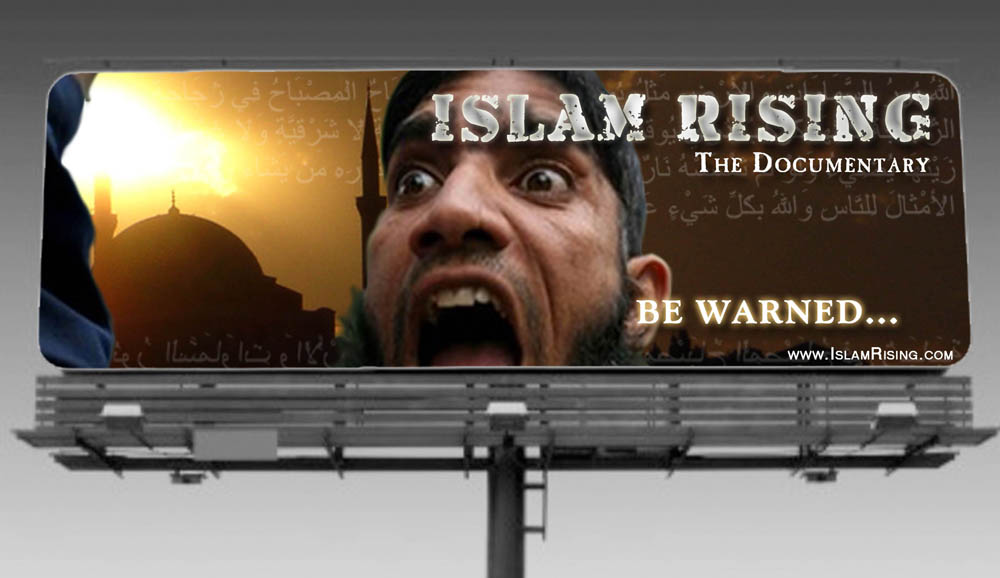
A former student directed me to this website after seeing billboards like this on the highway:

Religious Intolerance and Bigotry in contemporary America

I’ve been following with horror the media and right-wing frenzy over the so-called “Ground-Zero Mosque.” It’s not at Ground Zero, it’s almost a half-mile away and all those people, from Newt Gingrich and Sarah Palin to the Anti-Defamation League who are opposed to its construction seem also to be opposed to the First Amendment of the Constitution, that protects freedom of religion.

We’ve seen this sort of thing before. In the California town where opponents of a mosque were urged to bring their dogs to the rally (“because Muslims hate dogs”) this year, ten years ago, there was opposition to construction by the Latter Day Saints. They’ve run into difficulty over plans to build temples in many communities over the last couple of decades. Other religious groups struggle even more.

When we lived in South Carolina, Corrie and I were involved in Harvard’s Pluralism Project, which seeks to document the presence of religious communities in the US. As part of that work, we got to know Muslims, Hindus, and Buddhists, and learned about their difficulties in Spartanburg and Greenville in establishing places of worship. We also, very occasionally, tried to help some of these groups negotiate with their neighbors when tensions arose.

Besides the Capitol itself, Grace Church is probably the most recognizable landmark in Capitol Square, and its presence there bespeaks an earlier time when Christian churches were at the heart of American culture and power. That’s not the case any longer. It’s often tempting for Christians to view themselves as a persecuted minority, but I rather doubt that anywhere in the US the sort of outrage that has arisen over the construction of an Islamic community center and mosque would be generated by any church’s building project. And whatever slights we might receive in the press or wider culture, are nothing like the vitriol that Muslims have received from wide swaths of American culture in the past couple of months, actually since 9-11.

There are a number of sites that are following the various controversies that include news of a Florida church that plans a Quran burning on September 11. Among the best is Religion Dispatches. There are also several essays worth reading. One is by Jeff Goldberg of The Atlantic. It’s available here. Mayor Bloomberg’s remarks are here.

The Pluralism Project has tracked incidents of religious intolerance and intimidation for a number of years. They also archive examples of inter-religious cooperation. That website is here.

Another update

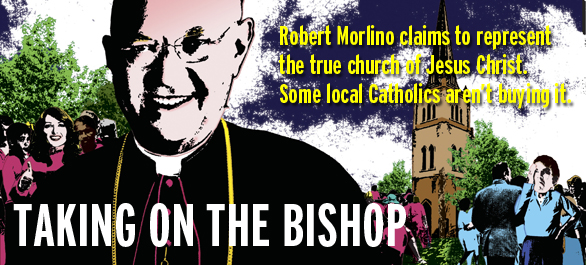
I received an apology from the Isthmus this afternoon. It turns out that the illustrator did use an image of Grace downloaded from the web as inspiration. Here is an excerpt from my reply:

Thank you. I appreciate your willingness to follow up with this matter. I don’t want you to get the wrong impression, given my reaction now to this second cover of Isthmus that references Grace. I’m quite willing to absorb the shots, when they are fair …. I am also well aware that religious institutions deserve much of the criticism they receive in our culture and that it is up to those of us in leadership positions and in the pews to work hard to gain the larger culture’s trust.

We are a long distance from the times when churches and religious institutions were at the heart of our culture and highly respected. The article behind the cover illustration is evidence of that. Still, it’s easy to take cheap shots at churches and religious institutions from the outside and for insiders who have a beef with their leadership to turn to the media for ammunition in their internal struggles. Outside criticism often has a negative effect, circling the wagons if you will.

Grace has experienced all of that over the years. Just as it’s important to defend our image, it is also important to admit to our failures publicly and to accept apologies when offered.

Madison, like all of American culture, needs a robust and watchful press to serve the public interest. Here’s hoping for a productive and challenging relationship with the Isthmus and with all of Madison’s media.

Money Changes Everything: A Sermon for Proper 13, Year C

Proper 13_YrC

Grace Church

August 1, 2010

One of the things I love about being back home in the Midwest is driving through the countryside. I grew up in a small town in northwestern Ohio; the church of my childhood was set in the middle of cornfields. Only after I moved away did I realize the spiritual power for me of those endless rows of corn and soybean fields, punctuated by big red barns and tall silos.

Corrie and I were driving through Wisconsin’s countryside this week and those same thoughts came back to me. Something has changed in the nearly thirty years since I left the Midwest, however. Back then, it was still the case that most barns had recent paint jobs, there were few that were in disrepair or crumbling. Now, it’s different. One can easily tell the active, successful farms from those barns and silos that are no longer in use. Many of the latter are decrepit; they look like just one strong wind might blow them over. Often these barns that are falling apart are relatively small, ill-suited to contemporary agribusiness, and crumbling for that reason. But there are others, that were clearly once the pride and joy of wealthy, successful families who had large acreage and herds.

We can see something of the history of rural America in that landscape. We see the prosperous and not so prosperous farms of a few generations ago. We also see the prosperous and not so prosperous farms of today. It’s easy to speculate about the families who lived and worked there, about their hopes and dreams. We can also see something of the widening gulf between rich and poor in rural America, for dotted among those prosperous farms are the house trailers and tumbledown houses of the poor. Continue reading