Urban/Rural

Even though I’ve never lived in Wisconsin before, I feel like I’m back home. I grew up in a small town in northwestern Ohio. When I was growing up, many people were no longer making their living in agriculture, and many farmers worked day jobs in factories. Still, life was dominated by agriculture. I would later joke that for fun, we had barbecues and watched the corn grow.

The area of South Carolina in which I lived was never dominated by agriculture. The economy and culture were very different.

We visited the Dane County Farmer’s Market on our first Saturday in Madison. Corrie has already gotten to know many of the farmers and we enjoy the products of their fields and pastures. As rector of a downtown church that is adjacent to the Farmer’s Market, I am intrigued by how we might minister in that context. What is our role? We are studying issues of food, sustainability, and hunger in our adult ed program this fall, but it seems to me there is much more that we could do.

I’m fascinated by a recent article in the Chronicle of Higher Education that discusses the plight of rural communities in the Midwest. It’s available here. Much of what is described resonates with my experience. It wasn’t so much that people urged me to leave. I never felt comfortable there, even as a child, so I jumped at the opportunity to leave, even if it was only to a college town slightly larger, ninety miles away.

Still, after I had really left the Midwest for Boston, I tried to come back for a summer, to see if I might live, and work, in my hometown. I realized I couldn’t.

The question I’ve been asking myself since I’m back in the Midwest is what is our role as an urban church, and my role as a priest in an urban parish, in reaching out to our rural neighbors?

The Book of Esther

On Sunday, we read from the Book of Esther, the only such reading in the three-year lectionary cycle. It is a story set in the Persian period, something of a folktale. The book exists in a number of versions–the Hebrew dates from the 4th century BCE, and there is contemporaneous Greek version that is considerably shorter than the Hebrew. Over the centuries, the book continued to change, so that a later Greek version, the one canonized by the Eastern Orthodox, is about a third longer than the original.

Apparently, The Book of Esther was wildly popular among Jews in the second temple period but the religious authorities were much more suspicious of it. It was canonized in the Hebrew Bible only in the first century CE. It became important in Judaism as the basis for the festival of Purim, which takes place in the month of Adar (February/March).

What puzzles me is why it is included in the lectionary here, and why the editors of the Revised Common Lectionary abridged the story in the way it appears. It is a tale of the cunning salvation of the Jewish people from an evil enemy. So far, so good. But the tale is also overflowing with violence, something our reading on Sunday passed over in silence. In many ways, the story of Esther and Mordechai, two faithful Jews who thrive at a foreign court, is parallel to the story of Joseph in Genesis 37-50. I suspect that a significant part of the reason for the appearance of Esther in the lectionary has to do with the desire of the lectionary editors to include stories about women.

In the Bob Jones University Art Gallery, hangs a marvelous painting of Queen Vashti by Edward Long.

Proper 21 Year B

“Whoever is not against us is for us”
Proper 21, Year B
September 20, 2009

What does it mean to be Grace Church? What does it mean to be the body of Christ that meets in this place? Those are questions I’ve already asked you from this pulpit before. They are questions I will continue to ask. My hope is that you have begun to ask them of yourself, that you have begun thinking and talking about them. They help us explore what our role in this community is. But they also explore what it means to be community and how to be community.

These are not easy questions for any one or for any congregation, but they are particularly difficult given Grace’s past. They would be difficult even if we didn’t have the history of conflict that we do, for in the twenty-first century, the question of community is at once more pressing than ever before. Community building is more difficult, even though technology seems to have made it easier to communicate.
Community and communication go hand in hand, one can’t create bonds across the aisle, across the generations, across cultural and linguistic divides without communicating clearly and carefully. Yet almost everything in our culture makes such communication more difficult. Our political discourse has devolved into shouting matches, people trying to score points rather than listening, and that carries over into the rest of our culture. Dialog is devalued in favor of making and scoring points.

And then there is the decline of face-to-face communities. Some of you have heard me tell this story before, but it’s a good one, so it bears repeating. As most of you know, I spent most of the last fifteen years teaching in liberal arts colleges as well as serving in ministry. Over that time a vast chasm opened up between my experience, my cultural values and those of the students I was teaching. Of course, that was inevitable. The students got younger every year. But the depth of that chasm came home to me one day in the classroom. As class ended that day, I noticed that as students began to leave the room, not one of the fifteen or twenty was talking to another student. Instead, they had all put in their Ipod buds, pulled out their cellphones, or continued sitting, checking their email. They had abandoned face-to-face community and communication for the virtual variety.

The most obvious reason for such behavior is that my students, even though they were at a small liberal arts college, preferred nurturing community with friends and family who were separated from them by a few hundred feet or hundreds of miles, rather than do the hard work of talking to someone who sat in the desk next to them. Most of us are tempted by such virtual communities. We have facebook pages with dozens, hundreds, sometimes, thousands of friends. We know what those friends are doing from minute to minute, thanks to the status postings. But what is the quality of those relationships?

Of course, it’s easy for someone like me to complain about social networking. I’m over fifty and the realities of the lives of younger people, even people in their thirties, elude me. I don’t text, I can barely see the numbers on a cellphone let alone try to use my thumbs to write messages with it. But it’s not just that. There are now virtual religious communities, apparently. In a way, it’s an extension of the televangelist phenomenon of the seventies and eighties. People related more deeply to the tv-star preacher than to their local church. Now, the relationship is with a virtual community, that may or may not involve real people.
Above and beyond that, here at Grace we worship as a community on Sunday morning, by and large in three distinct and separate congregations. Each week we have visitors who may or may not return, other people who come here seeking connection. But for the most part, we are community on Sunday morning. Some few of us may have relationships that are deeper than that; some of us have known one another for years, decades even, and so there is something of a core, or perhaps cores, webs of relationships. But on the outer boundaries of those webs, there are many others, who are tied to us by the slenderest of threads. With all of these obstacles, how do we create and nurture community?

We should take some small comfort in the fact that early Christian communities described in the New Testament struggled to create and maintain community. Paul’s letters are vivid evidence of the intense conflict that roiled early Christianity, but that conflict is also reflected elsewhere, even in the gospels.

The author of the letter of James urged his community to take care of its weaker members, the ill as well as those who might have strayed from the path. The image of community he depicts is one in which members pray for one another especially for the sick. But the ties that bind them are so strong that they also confess their sins to one another.

In the reading from the Gospel of Mark, we have a pot pourri of sayings, that seem somewhat disjointed. But what unites these disparate sayings is a concern for community. The first odd, saying of Jesus is in response to a rather strange event. An exorcist, who was not a disciple, was casting out demons by invoking the power of Jesus Christ. When the disciples complained rather bitterly, Jesus replied, “whoever is not against us is for us.” Now, what’s odd about this is that just earlier in Mark, the disciples had tried to cast out a demon and were unable to do so. The puzzle is what all this has to do with discipleship, but it would seem to me that Jesus is treating discipleship in rather expansive fashion, “whoever is not against us, is for us.

Then come the central teachings about community. As did the writer of James, Mark wants his readers to recognize the importance of maintaining the community, and the dangers that conflict within the community present. It is not just outsiders who are threats. For Mark, writing around the time of the great Jewish rebellion against Rome that culminated with the destruction of Jerusalem and of the temple, the Christian community faced severe, mortal threats from outside.

But there were also threats from within: “If any of you put a stumbling block before one of these little ones who believe in me, it would be better for you if a great millstone were hung around your neck and you were thrown into the sea.” The rest of the sayings ought to be read in light of that. It is not that one should pluck one’s eye out, or cut off one’s foot. What might a community, the body of Christ look like if all of us took seriously our responsibilities toward each other?

It is an exciting time at Grace Church. We have weathered a difficult period and come through. We have survived. But being the body of Christ is more than about keeping the doors open and the electricity on. It is about reaching out to others. Among congregational development literature there is an image that has become something of an old saw—the phrase goes “from maintenance to mission.”

In the weeks I’ve been at Grace Church I have come to learn a great deal about those people who have kept things going for the last decade, the last two or three decades. They’ve done incredible work. But they are tired and ready to pass the torch and the responsibilities on to the rest of us, to younger generations, with new energy and new ideas. In a few minutes, one of those torches will pass quite literally, as we install new leadership for the ECW, the Episcopal Church Women. But that’s only one organization, one area in which new leadership needs to come forward.

To take on those responsibilities, to live into our mission, we all need to roll up our sleeves, bend our knees, get to work, and to pray. We need to do the hard work to build community and the hard work of reaching out and extending that community beyond our doors, beyond the worship service which we find most comfortable, and comforting. The gospel for today concludes with a message that continues to resonate, “have salt in yourselves, and be at peace with one another.”

Proper 20, year B

“Good Advice, Bad Advice, No Advice”

Proper 20, Year B

September 20, 2009

It’s tempting for many to view scripture as a rule book, a how-to guide, with advice on how one ought to live one’s life. Of course, even for those most committed to such a view of scripture, there is much in scripture that they would and do ignore. For others of us, scripture is little more than a relic of a long-gone age, ill-adapted and irrelevant to contemporary culture. Perhaps many, or most of you, had that reaction while you were listening to this morning’s reading from Proverbs. Not only is it irrelevant, it seems at times downright dangerous.

Now, I could have taken the easy way out and used the alternative reading for today. In fact, there are two alternative readings, and either would be less jarring to contemporary listeners. But you may as well know now that I am not one to avoid a difficult text, or a difficult issue, simply because there’s an easier way. No, I like a challenge, and today we all are challenged by this image of the ideal wife.

Well, I’m not going to preach on that trope. And I will refrain from making any jokes about wives, ideal or otherwise. Rather, I would like to step back and take a look for a few minutes at where we’ve been in scripture these past few weeks, and where we are going. This September, we’ve been reading from the Book of Proverbs, and shortly we will shift from there to another book, the Book of Job for our lessons from the Hebrew Bible. Scholars put these two books, along with Ecclesiastes, and some apocryphal texts into a category called Wisdom literature. Wisdom is more than a genre or type of literature. It is also a world view.

What sets Wisdom literature apart from the rest of the Hebrew Bible is the approach its authors take. They are not interested in the Mighty Acts of God, salvation history. They are not interested in the exodus, or covenant, or even the law given by God at Sinai. Instead, they look closely at themselves, at the world around them, and try to derive principles for living from their analysis of human life. In Proverbs, this can be a very optimistic a very cheery look at life. Do this and you will be rewarded. The rules are clear, straightforward, and relatively simple to follow. As we will see when we begin reading from the Book of Job, there is another, rather pessimistic side to Wisdom literature.

Wisdom literature doesn’t downplay the importance of God. Rather, it assumes that one can see God in the workings of creation, human society, and in the mind. Earlier in Proverbs, in Chapter 8, there is the beautiful and famous, hymn to wisdom. It begins, «The Lord created me at the beginning of his work, the first of his acts of long ago… when he established the heavens I was there, when he drew a circle on the face of the deep… I was daily his delight, rejoicing before him always. It is significant, especially given the way our text talks about the ideal wife, that in both Hebrew and Greek, the word for wisdom is a feminine noun, in Greek, sophia.

When early Christians began to reflect on their experience of Jesus Christ, one of the important images they used was that of wisdom. So in the first verses of the Gospel of John, we have the famous hymn to the logos, the word, or reason.

We may not like the particular advice that Proverbs provides us with today, but we need to remember that it is conditioned by its historical and cultural context. The advice was probably the sort of common-sense advice that in an earlier age, but there is an important lesson for us to remember. The underlying notion that the universe as created by God is reasonable and its laws and ways can be understood rationally is a lesson that needs to be relearned time again. For the authors of wisdom literature, especially an author like that of Proverbs, or Ben Sirach, whom we hear occasionally in the lectionary cycle, natural law is subject to reason, to wisdom, and thus ultimately to God.

But there’s a tendency in the Christian tradition to downplay reason, to claim that human reason and wisdom are no match for God, that our reason will fail in the attempt. Often, supporters of such views will quote the words Jesus says in today’s gospel, “whoever welcomes one such child in my name welcomes me.” But that’s a misreading of this saying. There are several ways in which this has been reinterpreted. In Matthew’s gospel, for example, the parallel saying is transformed into the statement that “unless you become like a child, you will not enter the kingdom of heaven.” So when we hear Mark’s version, we tend to interpret it in light of Matthew.

There’s more to it, however. The Aramaic word that presumably underlies this saying, the language Jesus spoke, the same word is used for child and servant. So by drawing his disciples’ attention to a child, he is making the same point he made when he used the image of a servant. Thus we come back to the central point of this section. In today’s gospel, we have the second passion prediction by Jesus. Last week we heard the first, and in a few weeks, we will hear a third. Mark has shaped these into a very tight narrative pattern. Three times Jesus predicts that he will go to Jerusalem, will suffer and die, and be raised from the dead.

After each of these, the disciples make clear that they don’t understand what he is talking about. Last week, it was Peter. This week, Jesus embarrasses them by asking them what they had been discussing. Each time, Mark then follows it up with Jesus saying something about discipleship. Last week, it was “If any want to become my followers, let them deny themselves and take up their cross and follow me. For those who want to save their life will lose it, and those who lose their life for my sake, and for the sake of the gospel, will save it.” This week, an equally difficult saying, “Whoever wants to be first must be last of all and servant of all.”

I have to confess that this section of the Gospel of Mark among my favorites. It is also one of the most important sections. When I used to teach Bible, we would spend a day on these three chapters. When we came to the end of the gospel that we heard last week, That verse I just read to you, I would read it aloud to my students, most of whom were fairly conservative Christians, and ask them what they thought Jesus was telling them to do.

They would look confused for a moment, a common response to my questions, and then invariably, someone would try to explain. Well, Jesus is telling us that in order to be saved…” I would stop them right there and point out, that the saying goes, “whoever would save their life… will lose it. With these two sayings we are at the heart of one of his central teachings in the gospels.

Scholars often call it “reversal” or turning things upside-down. When Jesus teaches about discipleship or about the nature of the kingdom, the reign of God, he emphasized that what matters in the reign of God is a completely different value system than that which operates in our daily lives. What do we hold most dear? What is most important to us? Our life? Our family? Our health? Our wealth? Eternal Life? Whatever that is, the reign of God, according to Jesus, turns that value on its head. Whoever would be first will be last, the last will be first. Whoever will gain his life will lose it. Whoever would be greatest will be the least.

Hard as that may be for us to hear, and it is hard, because it challenges almost everything we hold dear—status, position, wealth, power, if you really think about what Jesus is saying, he is challenging even those things that we would do, those things we would give up for the kingdom. He is challenging even our deepest religious values. Whoever would save his life will lose it.

Proverbs would give us advice about human life. There are self-help gurus with infomercials, and how-to books who offer us the same. Oprah and Dr. Phil are ready with easy steps for happiness, and wealth, and weight loss. Jesus offers us none of those things. There is no twelve-step path for discipleship or for realizing the reign of God. Instead, Jesus confronts us with a call and a challenge: Whoever wants to be first must be last and servant of all. That’s not a recipe for success, survival, or recovery. That is the mindset of a disciple who walks with Jesus to the very end.

Lancelot Andrewes (1555-1626)

Lancelot Andrewes ended his career as Bishop of Winchester, after holding two other sees earlier. A famous preacher and biblical scholar, he was a member of the committee that produced the translation that came to be known as the King James Version, and thus his language came to have an immeasurable impact on the English language, on Anglo-Saxon culture and on spirituality. He was a scholar of Greek, Hebrew and Latin, and so proficient in all three that the private devotions he wrote for himself were written in those Biblical languages, not in his mother tongue. The Private Devotions were published after his death, and translated into English. Here is one of his prayers:

PRAISE

Up with our hearts;
we lift them to the Lord.
O how very meet, and right, and fitting,
and due,
in all, and for all,
at all times, places, manners,
in every season, every spot,
everywhere, always, altogether,
to remember Thee, to worship Thee,
to confess to Thee, to praise Thee,
to bless Thee, to hymn Thee,
to give thanks to Thee,
Maker, nourisher, guardian, governor,
preserver, worker, perfecter of all,
Lord and Father,
King and God,
fountain of life and immortality,
treasure of everlasting goods.
Whom the heavens hymn,
and the heaven of heavens,
the Angels and all the heavenly powers,
one to other crying continually,—
50and we the while, weak and unworthy,
under their feet,—
Holy, Holy, Holy
Lord the God of Hosts;
full is the whole heaven,
and the whole earth,
of the majesty of Thy glory.
Blessed be the glory of the Lord
out of His place,
For His Godhead, His mysteriousness,
His height, His sovereignty,
His almightiness,
His eternity, His providence.
The Lord is my strength, my stony rock,
and my defence,
my deliverer, my succour, my buckler,
the horn also of my salvation
and my refuge.

(from http://www.ccel.org)

The Staffordshire Hoard

There’s a remarkable story in the BBC about the discovery in England of a large collection of items from the seventh century. Found by an amateur with a metal detector, it is one of the most significant archaelogical finds in modern times. Much of what we know about the Anglo-Saxon period comes from the Venerable Bede’s Ecclesiastical History of the English People, written in the early eighth century but over the years there have been also a number of important archaeological discoveries, most notably at Sutton Hoo.

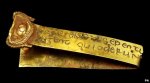
This find seems to come from the Mercian kingdom, about which Bede had relatively little to say, because they remained pagan. But among the discoveries is this item which has engraved on it, in Latin, “Rise up O Lord, and may thy enemies be dispersed and those who hate thee be driven from thy face.”

Here’s an image of it:

image1

Historians and art historians will have much to ponder.

In Search of Communion

A recent article by Deb Cuny in Episcopal Life provides some insight into the attraction of the Episcopal Church for people, and some of the things that limit our appeal. You can read the entire article here.

The key passage:

As a permanent first-time visitor on this trip, I saw how a church’s visibility was critical when selecting churches. I used the web to do my research from town to town. For me, it was important to find a friendly, comfortable and young “feeling” church. That meant that I favored churches with a current website that was clean in design, branded and creative. I also searched for churches with updated online calendars that had cultural programming targeted at my age group. I especially loved programs that brought the church to the world instead of requiring that the world enter the church.

She offers suggestions for appealing to young people and improving communications. Some of this we do at Grace, but we could do much better.

Moving the Furniture

I published this to the parish last week:

The new rector has begun to move the furniture around! There’s a joke in Interim Ministry that one of the chief jobs of an Interim is to move the furniture around in the church. The idea is to break people from old customs and old habits. When I visited Grace Church before receiving my call, I noticed that there were two baptismal fonts. One, filled with water, was at the entrance to the nave. When I returned in August, that font had been placed somewhere else, out of sight.

I hope you have noticed that it is back at the entrance to the nave, filled with water. That is where it belongs, not just on Sundays when there are baptisms, but every day throughout the year. It should be filled with water that has been blessed by the priest. Some of you may be uncomfortable with that, thinking it is too “Catholic.” In fact, there are sound theological and spiritual reasons for its placement there. We, all of us, enter the church through the Sacrament of Baptism. The font is a reminder of that and of our baptismal vows. It should be a source of reassurance when we are troubled or doubting—an aide-memoire for the words in the sacrament, “You are sealed by the Holy Spirit in Baptism and marked as Christ’s own forever.” The font reminds us of that. Dipping one’s fingers in the font, and marking one’s forehead with the sign of the cross is not some superstitious guard against vampire attacks (garlic works better), but another, concrete reminder of the waters of baptism in which we have been washed.

The person who can guess which piece of furniture will be moved next will win a prize.

Apparently some parishioners are trying to figure out what I’ll move next while others are concerned that I might move something important. It won’t be the altar rails and the reference to vampires might be a clue that I am not always to be taken literally.

Curiosity and Wisdom

Given the topic of my sermon this morning, I came across this discussion by Stanley Fish of curiosity. Taking off from a recent speech by James Leach, the Director of the National Humanities Administration, Fish asks whether curiosity has positive religious connotations, whether it is a virtue or a vice.

Oddly, he begins with Adam instead of Eve. Genesis 3 states quite clearly that Adam wasn’t involved: “So when the woman saw that the tree was good for food, and that it was a delight to the eyes, and that the tree was to be desired to make one wise, she took of its fruit and ate; and she also gave some to her husband, who was with her, and he ate” (Genesis 3:6, NRSV).

“The tree was desired to be desired to make one wise.” There is of course in the biblical (and the Christian) tradition that denigrates the quest for wisdom, but there is also, as I said in my sermon, a strand that views wisdom as a way of approaching God

Update on Developments in Anglicanism

I hesitate to comment on recent events in the Anglican world, but things seem to have heated up since General Convention. If you want to keep abreast of developments, check out the blogs I’ve listed. They aren’t particularly representative of the complete spectrum of positions, but their authors are thoughtful, and the comments often insightful.

Soon after General Convention, the Archbishop of Canterbury, musing on the passed resolutions and their implications for the Anglican Communion, posited the development of a “two-track” approach in which the Episcopal Church might be left out in the cold if it refused to sign on to a covenant, while individual dioceses could sign on. In August, the ABC met with seven “communion partner” bishops, who apparently stressed their commitment to Covenant and Communion.

After the ABC’s pronouncement, rumblings from the Church of England were heard, as the liberal wing of that Church began to voice its support for the Episcopal Church and began seeking ways of strengthening ties with it.

Most recently, the Diocese of South Carolina has issued statements about its future in the Episcopal Church. It seems headed for everything but outright separation. It also seems to want to emerge as yet another umbrella organization.

In other words, plus ca change…

I have stated in the past, and I continue to think that the notion of a covenant is a non-starter, for all sorts of reasons. The genius of Anglicanism, and its appeal, has traditionally been its messiness–or to use another word–its ambiguity. I have never accepted the theological, historical, or ecclesiological arguments for papal supremacy and I am not about to accept an Anglophone version of it.

The problem with the Anglican Communion for me is not the idea of it. Rather, what I question is the way it is made concrete. Of the “Instruments of Communion” only one, the Anglican Consultative Council, draws its members from outside the Episcopacy. That’s dangerous and anti-democratic and hardly consistent with the vision of the Church presented in the New Testament.