Breathing life into Diocesan Convention?

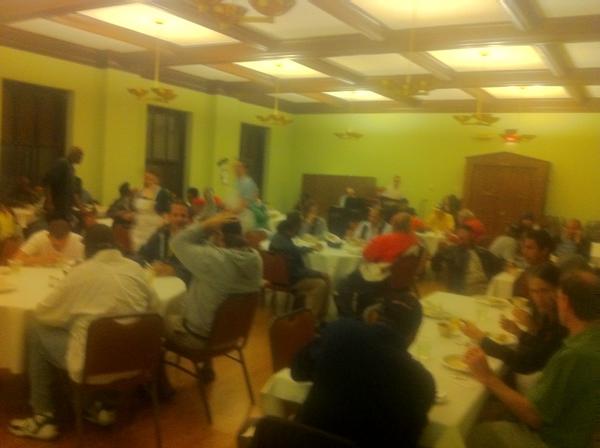
Yesterday, the 165th Convention of the Episcopal Diocese of Milwaukee met. Details of the gathering are here.

There were two resolutions: one a change to the canons to permit vestries of six members; the other the annual minimum compensation for clergy. Neither elicited any debate. There were only two contested elections (for a lay member of Executive Committee, and for a clergy slot on Standing Committee).

I wasn’t able to stay for the discussion of the budget but from my twitter feed, it seems that there was little debate on that. In fact, a newcomer to the diocese observed that the explanation of the rules for debate took up more time than the debate itself. It’s as if we were going through the motions–doing things that needed to be done without any energy or excitement.

The only time it seemed the room began to fill with ideas and energy was as we talked around our tables about three questions Bishop Miller gave us at the end of his address. Here they are:

How is your congregation experiencing new life?
How do we, continually ourselves and others to see the new life God is calling forth and deepen our relationship with God?
How can diocesan structures and ministries help you in these efforts?

The questions were oriented toward the diocese’s ongoing strategic planning process in which I participate as a member of the task force.

It got me thinking, though. We’ve been talking a great deal about restructuring the church, on the congregation, diocesan, and church-wide level. Diocesan conventions seem ripe for complete rethinking. Every year, several hundred of the most committed Episcopalian Christians gather in each diocese to elect members to various bodies, debate resolutions, and pass budgets. I’ve never met anyone who said they love the business session of a convention. We do it because we have to do it, because we can’t imagine another way of doing it. But here we are, several hundred of us, gathered to work and worship. We hang out together, rekindle relationships, make new friends. How might we use our time together more effectively: for teaching and learning, for asking big questions and hearing about new initiatives? For praying? Studying the Bible? Instead, we go through the motions of doing business. In our diocese, we hear the Bishop twice, preaching the sermon during the Eucharist and his pastoral address during the business session. Instead of listening, how might we foster more conversation, dialogue, and listen for the movement of the Holy Spirit?

Here’s Bishop Miller’s Pastoral Address to the convention.

John O’Malley on Vatican II

My teacher, mentor, and friend writing in the NY Times on the fiftieth anniversary of the opening of the Council:

The bishops at Vatican II felt that more than a century of centralization needed to be tempered. But in their euphoria, they failed to reckon sufficiently with the resistance of entrenched bureaucracies — jealous of their authority and fearful of disorder — to change. A more participatory mode of church life took hold for 15 years or so after the council, but from on high it began to be more and more restricted, to the point that central control is now tighter than ever.

And in the long historical perspective of Catholicism:

The post-Vatican II church was not a different church. But if you take the long view, it seems to me incontestable that the turn was big, even if failures in implementation have made it less big in certain areas than the council intended.

I wrote about O’Malley’s What Happened at Vatican II here.

Bishops behaving badly: Civil War Edition

On the NYTimes Opinionator, a profile of Leonidas Polk. In Sewanee, I knew him as the Battling Bishop, but the Opinionator calls him the Fighting Bishop. Either way, he was apparently one of the worst generals in the Confederate Army.

A graduate of West Point, he attended Virginia Theological Seminary and was first the Missionary Bishop of the Southwest, then the first Bishop of the Diocese of Louisiana. The article notes the important role he played in founding The University of the South

His portrait hangs (I assume still) in Convocation Hall of the University of the South:

Of his military skills, one historian wrote:

In his history of the Army of Tennessee, Thomas Connelly condemned Polk’s “remarkable ability to evade the blame for situations that were the result of … flaws in his character.” Polk, Connelly claimed, could be “stubborn, aloof, insubordinate, quarrelsome, and childish.” He was, put simply, “the most dangerous man in the Army of Tennessee.”

No word in the article about his skills or gifts as a bishop.

Another Pew Survey: The numbers of religiously-unaffiliated spike again

Here is the story from Rachel Zoll of the AP. Full results of the survey are available here.

About the “nones,” now approximately 20%: They may believe in God; they may pray; they may be “spiritual but not religious.” But they do not affiliate with any religious organization nor do they want to:

Pew found overall that most of the unaffiliated aren’t actively seeking another religious home, indicating that their ties with organized religion are permanently broken.

Alan Jacobs ponders the significance of this:

The question I would ask is this: Has there been an actual increase in religiously unaffiliated people, or do people who are in fact unaffiliated simply feel more free than they once did to acknowledge that fact? My suspicion is that until quite recently a person born and baptized into the Catholic church who hadn’t attended Mass in fifteen years would still identify as a Catholic; but recently is more likely to accept his or her unaffiliated status. There is less social (and perhaps also psychological) cost in saying “I have no particular religion that I’m connected to” than there once was.

That is, the poll may reflect not a change in behavior but a change in how people think of their behavior — a change that brings their self-descriptions more closely into line with reality. And that wouldn’t at all be a bad thing: there’s always something to be said for the removal of illusions, for “reveal[ing] the situation which had long existed.”

Most striking about all this are the generational shifts. Among “millennials” the numbers are shocking. Of younger millennials (those born between 1990 and 1994), 34% claim no religious affiliation. Older millennials are only slightly more likely to be involved in organized religion (30% now compared to 26% in 2007). The number of unaffiliated Gen-Xers and Baby Boomers has also increased; the latter in spite of recent articles trumpeting the return of Boomers to church.

What are we to make of this? I think it’s right to say that part of it is that there is less stigma attached in saying one does not attend church. On the other hand, I suspect that a willingness to self-identify as non-religious reflects behavioral and attitudinal change.
Growing numbers of Americans simply don’t seem to care about institutional religion. It is irrelevant to their lives.

This certainly has enormous implications for denominations and local congregations. If large numbers of young people have no inclination to get involved in church, no interest in attending services even on Christmas or Easter, or being married in a church, that means they are seeking meaning in other places and in other ways than through traditional religious language and categories. It may be that they are not even asking questions about themselves, their lives and the world that can be engaged in religious terms.

This is what “post-Christian” culture looks like. It’s not simply a matter of a decline in prestige, power, and influence for the churches. If the trend continues, how many young adults will claim no religious affiliation 10 years from now? 50%? More?

How do we proclaim the gospel in this context? What does it mean to be church? For Anglicans, it won’t be enough to say that we offer a “via media” or that “The Episcopal Church welcomes you.” People won’t understand what the former means and won’t even see the latter sign.

Blessing Relationships: A Sermon for Proper 22, Year B (and the Blessing of the Animals)

October 7, 2012

There are those who look forward to this Sunday each year with great excitement. We are blessing the animals today, on this closest Sunday to October 4, which is the Feast Day of St. Francis. We bless the animals in conjunction with the commemoration of St. Francis because among so many other things, Francis was known for his love of the animals—among the stories his followers and devotees told about him were his preaching to the birds, taming the wolf of Gubbio, and more. Francis’ love of the animals was part of his delight in all of creation, as we sang in our processional hymn words attributed to him in praise of creation. Continue reading

St. Francis of Assisi–October 4, 2012

St. Francis of Assisi is among the most beloved, perhaps the most beloved of the saints. We are drawn to his simple, child-like love of Jesus Christ, his preaching to the birds, his impulsive actions in trying to make the gospel concrete for himself and those around him, his attempt to bring peace between Crusaders and Saracens. In the twenty-first century, he is revered as a proto-environmentalist.

But there are aspects of his biography and his piety that elude our grasp to comprehend and occasionally alienate modern sensibilities. His visceral hatred of money, for example. Also, perhaps, his devotion to the passion and suffering of Jesus Christ. His identification was so complete that he received the stigmata, the wounds of Christ on his own body, during a mystical vision. Here’s the classic rendering of that event, from a fresco, attributed to Giotto, in the Basilica of St. Francis in Assisi:

St. Francis is a model saint not only for who he was and what he did, not only because of the deep devotion he had for Jesus Christ, and for the deep devotion he has inspired in millions of Christians over the centuries. St. Francis is a model saint because he continues to challenge us to reflect on our faith, to deepen it, and to be bolder and more complete in our imitation of Jesus. His continuing “otherness” challenges us to confront our compromising attitude to the world, to our selfish desires, and our comfort.

St. Francis died on this day in 1226.

Winter is getting closer, so that means the debate over homelessness is ramping up again

So the county has proposed a day shelter for Madison’s eastside, a site picked apparently out of the blue and with no input from the neighborhood. Mayor Soglin is outraged because the city wasn’t consulted and is having none of it. What frustrates me is that we’ve come down to the last minute again. Here it is early October and there are no definite plans in place for providing day shelter in the winter. No doubt the powers that be are hoping the problem will just go away and that when the library reopens next year, the seasonal fuss will die down.

Soglin is convinced that Madison is a magnet for homeless people from across the region:

“I have made it clear that the city of Madison does not have the resources or the responsibility to take care of Dane County’s and Wisconsin’s homeless population,” Soglin wrote.

Has he noticed that it is a magnet for people with homes as well? For students and young adults?

In fact, on Sunday I met a homeless man who asked me if I could make some copies of his resume. He is in Madison because he came here from a small town elsewhere in the state, not in hopes of mooching off of Madison’s largesse, but because he’s looking for work. The unemployment rate is much lower here than elsewhere in the state, lower than most of the small towns that dot the countryside.

The debate over a day center is not about providing a hang-out. It is about basic human needs–providing shelter from inclement weather–and about providing services as efficiently as possible. Rather than forcing people to traipse across the city lugging their possessions while they search for food, laundry facilities, a shower, as well as a job, a day center would put most of those services in a single place and staff it with human service professionals who could help people negotiate the labyrinthine bureaucracy of city, county, state, and federal services.

Madison.com coverage of the day center controversy is available here.

Chris Rickert writes here about Mayor Soglin’s position.

Meanwhile, we fed about 100 people last night at First Monday: meatloaf, potatoes, green beans, ice cream. Music ranged from Leonard Cohen to Opera and was very well received. There were men and women, including one family who enjoyed our hospitality:

Consider your servant Job: Lectionary Reflections for Proper 22, Year B

This week’s readings are here.

One of the great problems with the lectionary is that its editors had to pick and choose texts and inevitably were able to include only portions of important works. That was a problem with last week’s reading drawn from the book of Esther. The same is true this week as we move into another book from the Hebrew Bible, Job. We will have a total of four readings from the book: this one, from the first and second chapter that sets up the problem. Later readings will introduce us to Job’s challenge of God; essentially Job puts God on trial. Later we will hear God’s response to Job’s case for the prosecution and finally we will hear how it all ends up (Job is richer than ever). Omitted are lengthy speeches from Job and Job’s friends that raise questions about divine justice and theodicy (why bad things happen to good people) as well as the initial tragedies that befall Job’s family.

This brief introduction to the book fails to do justice either to its literary genius or its theological depth. A careful reading of the whole book is most rewarding and brings a profound challenge to the complacency of our faith. It also helps to overcome the image of Job in popular culture—the patience of Job is a trope, but in fact the Job of scripture is not patient at all, nor does he suffer silently. He demands that God explains why suffering has come upon him.

In this week’s reading, we have the second of two encounters of God with “The Satan.” The portrayal of the Satan in the text is curious. In chapter 1, he seems to be a member of God’s heavenly court and it’s almost as if God and Satan have made a bet (“Have you considered my servant Job?”). God draws Satan’s attention to Job as a righteous man, and Satan responds by saying that Job is righteous only because he’s had it easy. So God responds to the challenge by allowing Satan to test Job, giving him power to take away all that Job has, and in chapter 2, to afflict Job himself, but forbidding him to take his life. Job is left with nothing, riddled with disease, and still he does not curse God.

The book’s answers, such as they are, will come later, in God’s response to Job. In fact, the book’s fundamental question remains unanswered and remains one of humanity’s most basic questions, asked every time there is a natural disaster, or when illness or death comes to a loved one. We want life to make sense, we want the world to make sense, but too often, it all seems meaningless. But as the Burial Office says,

“All of us go down to the dust; yet even at the grave we make our song: Alleluia, Alleluia, Alleluia.”

Be Salt! A Sermon for Proper 21, Year B

September 16, 2012

As many of you know, Grace Church has embarked on a master planning process. Beginning today over the next several months various groups and constituencies will have the opportunity to weigh in about our spaces—what works, what doesn’t work, what needs renovation and enhancement, what should remain pretty much like it is today—All of you will have an opportunity in a few minutes to offer your wisdom and perspective. We hope that everyone here will fill out a survey, whether this is your first visit to Grace or whether you’ve been a member for sixty years. Continue reading

September 26: Lancelot Andrewes “For Holy Communion”

Today is the commemoration of Lancelot Andrewes. Here’s a biography.

FOR HOLY COMMUNION

O LORD, I am not worthy, I am not fit,
that Thou shouldest come under the roof of my soul;
for it is all desolate and ruined;
nor hast Thou in me fitting place to lay Thy head.
But, as Thou didst vouchsafe
to lie in the cavern and manger of brute cattle,
as Thou didst not disdain
to be entertained in the house of Simon the leper;
as Thou didst not disdain that harlot, like me, who was a sinner,
coming to Thee: and touching Thee;
as Thou abhorredst not her polluted and loathsome mouth;
nor the thief upon the cross confessing Thee:

So me too the ruined, wretched, and excessive sinner,
deign to receive to the touch and partaking
of the immaculate, supernatural, lifegiving,
and saving mysteries of Thy all‑holy Body
and Thy precious Blood.

Listen, O Lord, our God, from Thy holy habitation,
and from the glorious throne of Thy kingdom,
and come to sanctify us.

O Thou who sittest on high with the Father,
and art present with us here invisibly;
come Thou to sanctify the gifts which
lie before Thee,
and those in whose behalf, and by whom,
and the things for which,
they are brought near Thee.
And grant to us communion,
unto faith, without shame,
love without: dissimulation,
fulfilment of Thy commandments,
alacrity for every spiritual fruit;
hindrance of all adversity,
healing of soul and body;
that we too, with all Saints,
who have been well‑pleasing to Thee
from the beginning,
may become partakers
of Thy incorrupt and everlasting goods,
which Thou hast prepared, O Lord, for
them that love Thee;
in whom Thou art glorified
for ever and ever.
Lamb of God,
that takest away the sin of the world,
take away the sin of me,
the utter sinner.

–From Lancelot Andrewes, The Devotions of Bishop Andrewes, Vol. I (accessed at the Christian Classics Ethereal Library)