
Pastors need to be challenged and disrupted

Patheos is running an online symposium on the future of seminary education. Like higher education in general, graduate education for clergy is in a crisis–rising tuition, rising debt for students, shrinking enrollments.

Reading the various entries brought home to me how inadequate my education at Harvard Divinity School was. We knew it was at the time; HDS offered very little in the way of courses in the practice of ministry. But it finally dawned on me that there was an even larger disconnect. I remember thinking at the time  I was doing my field ed in a struggling mainline parish in Boston’s Back Bay that it seemed that the only people attending church were elderly or so disfunctional because of mental illness, substance abuse, or other forms of abuse, that what we were learning at HDS had no relevance in the pews or on the streets.

Fifteen years in the south were somewhat deceptive. Attending church was still culturally acceptable, even expected. It was easy to imagine that the Church could survive, perhaps even thrive in the American landscape. I remember how surprised I was when I began teaching at Sewanee to find seminarians who had come from suburban churches and were expecting to return to similar congregations where they would face no greater challenge than making sure acolytes were wearing black shoes. It seemed like we were still in the 1950s. Sometimes I wonder how many of those students I taught are still in the priesthood and whether their education has prepared them well for the challenges facing the church in the second decade of the twenty-first century.

I wonder whether seminaries, by their very nature blind students and faculty to the reality of the outside world. For denominational seminaries, even those in the throes of survival struggle, there still may be a sense that if we can just get it right, the institution will survive. I know that for many who enter the ordination process in the Episcopal Church, think of it not as an ongoing challenge, but only as a series of hoops through which to jump on one’s way to the promised land of a a settled cure somewhere. The ordination is designed to create clergy invested in the denomination as it stands, because the promise of an well-paying job and a secure pension are the pot at the end of the rainbow.

The most recent entry in the symposium comes from Kurt Fredrickson of Fuller Theological Seminary, who advocates for those institutions “to serve and resource the whole church.” But the most compelling thing he said is the phrase that appears as the title of this blog post: “Pastors need to be challenged and disrupted.”

I think that’s exactly right, and more true for denominational seminaries than for non-denominational ones or for divinity schools. In the latter, students will be challenged and disrupted by the encounter with students from other religious traditions. In the former, the tendency is to do little more than indoctrinate students in the denominational culture, which by any measure, is in radical decline.

The new bishop of the Diocese of Washington

Mariann Edgar Budde was consecrated Episcopal Bishop of the Diocese of Washington on Saturday. Here’s the report from The Washington Post.

The Post also printed her first sermon as Bishop, preached yesterday.

Here are two key excerpts:

We of the Episcopal Church have been entrusted with a particular expression of Christ’s gospel that is priceless. Think of what it means to you to have a spiritual home with such an appreciation of mystery and all that is beyond our knowing and curiosity about the world as we can know it through the rigorous inquiry of science. Think of what it means to you to have a spiritual home that lives the Via Media, the middle way among all expressions of Christianity, affirming the wholeness of faith that can only be fully experienced in the creative tension of polarities — heart and mind, Catholic and Protestant, word and sacrament, mysticism and service, contemplation and social engagement. Think of what it means to you to be part of a Church that does not ask its members to agree on matters of politics or theology or biblical interpretation, but rather to allow the grace of God to unite us at the altar of Christ in full appreciation of our differences and the God-given right of everyone to be welcome at God’s table.


And:

You have called me as your bishop at the time when the first priority for the Episcopal Church is the spiritual renewal and revitalization of our congregations and core ministries, not as a retreat from social and prophetic witness, but in order to be more faithful to that witness, with greater capacity not only to speak but to act in God’s name. This is a time when the cultural and societal context in which our churches find themselves is constantly changing, and we must learn how to sing our Lord’s song in a new land.  It’s a time when we aren’t sure yet what we need to let go and what to keep, what is essential to our identity and what is secondary. It’s a time of deep spiritual longing yet superficial spiritual grounding, and that’s as true within our congregations as outside them.

Lectionary Reflections for Christ the King Sunday

This week’s lectionary readings.

Next Sunday is the last Sunday of the liturgical year, known as Christ the King. Next Sunday, the first Sunday in Advent, begins a new lectionary cycle. Advent will begin with a focus on the coming of Jesus Christ—both his first coming and his second. Today’s lessons also focus on Christ’s second coming and our lessons emphasize Christ reigning in majesty and his reigning as a judge. This gospel reading is not only our last for this year. It is also the last substantive teaching that Jesus gives his disciples before his crucifixion. So, for Matthew, apart from a few commandments Jesus gives his disciples—the institution of the Eucharist and the Great Commission—this story is Jesus’ last words to his disciples.

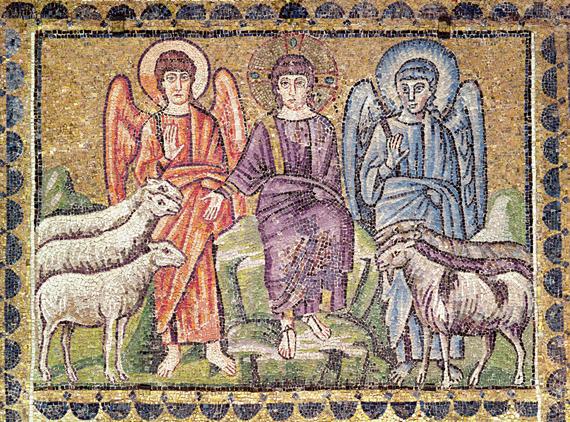
So it’s an important story, not simply because it’s a favorite of those who see the Gospel message as primarily one of outreach to the needy. It’s important for Matthew, too.  It’s an apocalyptic vision. Jesus is describing what the Parousia—the coming of the Son of Man will be like. First, he uses royal imagery. He will come in glory and sit on his heavenly throne. But immediately, that imagery is combined with another image, that of the shepherd. He will separate the people like a shepherd separates his flocks, the sheep from the goats.

This image may draw us back to the reading from Ezekiel, where another visionary sees God coming like a shepherd, judging between the fat sheep and the lean sheep, rescuing them from wherever they have been scattered, feeding them, binding up the injured. We might find it odd that these two images—the shepherd and the king—are linked together in the biblical tradition. As the reading from Ezekiel makes clear, one reason for that linkage is the tradition that the founder of the Davidic monarchy—King David, was a shepherd. But for Christians, when shepherd imagery is used of Jesus, it is almost always used to emphasize Jesus’ care for us and his intimate love for us.

Yet here in Ezekiel, the shepherd is a judge who culls his flocks, separating the fat from the lean sheep. So too in the gospel, the Shepherd King is a Judge who divides the sheep from the goats. In the Ezekiel passage the contrast between the care and tender concern the shepherd shows for the lean sheep and the harsh words with which he judges the fat.

The same is true in the gospel. The king judges harshly, unequivocally between the sheep and the goats. Christ appears to us here as a shepherd-king, but there are two other important images of Christ in the gospel. One is the obvious one. When the king says, inasmuch as you did it to one of the least of these my brothers and sisters, you did it to me, identifies the presence of Christ in the naked, the prisoner, the hungry, the sick. The third image is less obvious. The text begins with a reference to the Son of Man. In Matthew, when Jesus uses that title of himself, it almost always is in reference to his crucifixion. Christ the King is also the Crucified One and the least of these.

We are called to hold these three images together, we might think of them as three facets of a prism that together refract the light. If we ignore one of them, the other two become less brilliant. Emphasizing one over the other is a common temptation for Christians, but the gospel itself warns against it. We might prefer one image over the other. Some might want to encounter Christ only in the face of the poor and hungry; others only in an image of the Crucifixion. There are even those who can conceive of Christ only as the judge who comes on a cloud of thunder and reigns in majesty.

Each image taken by itself will lead to a distortion of our faith. Those who focus only on the crucifixion will see Jesus only as the one who offers forgiveness for our sins. Those who focus on Christ in Majesty will think only about the second coming and making sure that they are on his right side. Those who focus only on outreach to others turn the Christian message into a social service agency.

The judge separates sheep from goats, those who reached out to the needy and those who didn’t. The surprising thing here is that all are surprised. Neither group knew that Christ was present in the naked, the stranger or the prisoner. So for those whom the King welcomed into the kingdom, their actions in reaching out to the needy were not a conscious response to Jesus’ teachings or the result of acting out of duty or in order to gain their salvation. Their actions were an unconscious, unknowing part of who they were as Jesus’ disciples.

Each year as Christ the King Sunday approaches my mind turns to the marvelous mosaics in the churches of Ravenna, Italy, created in the sixth century on behalf of Byzantine emperors. There are two that are especially appropriate on this occasion. The first is from the Mausoleum of Galla Placidia, depicting Christ as the Good Shepherd:

The second is in S. Apollonare Nuovo, showing Christ separating the sheep from the goats: