
Reign of Christ
November 26, 2023
It’s been nearly forty years since I’ve visited Ravenna, Italy but its churches and their mosaics are still alive in my memory. So too is the awe and wonder that they evoked in me then. In the sixth century ce, Ravenna was the western capital of the Byzantine Empire, and the emperors and their families undertook a vast building project to express their power and faith. The mosaics conflate and combine imperial and religious imagery and while their meaning and significance are much debated among art historians and historians of late antiquity, their power, in the sixth century and today, are not.
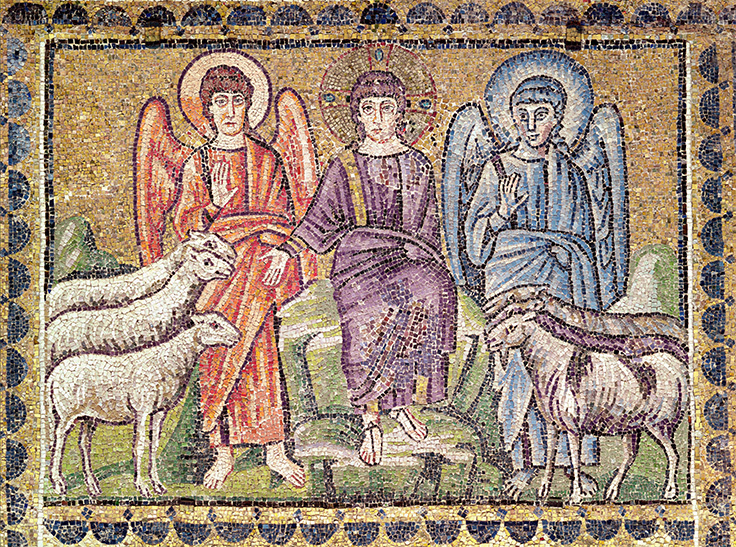
You can see that imagery on full display on the the cover illustration of today’s service bulletin. What you cannot see is that in addition to looking like a ruler sitting on a throne, Christ in this mosaic is clad in imperial purple, wearing all the trappings and symbolism of a Roman emperor.
I chose that image because today is the observance of Christ the King, or the Reign of Christ in contemporary parlance, is a 20th century innovation, this mosaic seems to capture perfectly the lectionary choice of Matthew 25:34-46. Christ, reigning in majesty, separating the sheep from the goats.
Thinking about this image in the context of the parable may help us to encounter the story with new eyes, for it has become something of a favorite for many of us, a way of thinking about our responsibilities as followers of Jesus and to distinguish our sort of Christianity from that of many others—a focus on doing good rather than believing correctly. That interpretation is both comforting and self-gratulatory, and as always with the parables, I want us to experience its strangeness.
One way to do that is to note its context and the parables that precede it. Over the last few weeks, we’ve heard the parable of the wise and foolish bridesmaids, the talents, the wedding banquet. The parable of the wise and foolish bridesmaids concludes with the foolish ones locked out of the banquet hall. The parables of the wedding banquet and the talents end with someone cast into outer darkness, where there is weeping and gnashing of teeth. This one ends similarly with the goats banished to eternal punishment.
After the last two Sunday gospel readings, two parables of judgment and warning about the return of Christ, two parables that make us uncomfortable both in their urgency and in the message of judgment they proclaim, the judgment in this parable seems to support all of our prejudices and values.
In today’s reading, we are inclined, thanks to two thousand years of Christian reflection on this story, to see the separation of sheep and goats into good and evil as obvious, a given. Well, not so fast. In the ancient near east, goats were a prized animal. Their milk and meat were staples. They were not seen as evil—a goat was an acceptable sacrifice in Israelite religion.
Perhaps more interesting is the fact that it was a common practice to keep goats and sheep together in a single flock. The only time the two animals were separated by the shepherd was on cold nights, when goats needed more protection. In short, in this reading as in the two preceding parables, the separation of sheep and goats into good and evil, is rather arbitrary.
In fact, that’s something of a theme in Matthew’s gospel, that one can’t distinguish good from evil until the time of judgment—remember the parable of the wheat and the weeds, when “the devil” sowed weeds in a field and the farmer said that at the time of harvest, the wheat and the weeds would be separated and the weeds burned. So there’s something typically Matthean about this whole passage, something that Matthew as a gospel writer is especially interested in. It’s probably a result of something I mentioned a couple of Sundays ago, that a central concern for early Christians that Jesus had not yet returned.
I would like to draw your attention to something else in the text. Jesus is describing what the coming of the Son of Man will be like. First, he uses royal imagery. He will come in glory and sit on his heavenly throne. But immediately, that imagery is combined with another image, that of the shepherd. He will separate the people like a shepherd separates his flocks, the sheep from the goats.
This image may draw us back to the reading from Ezekiel, where another visionary sees God coming like a shepherd, judging between the fat sheep and the lean sheep, rescuing them from wherever they have been scattered, feeding them, binding up the injured. We might find it odd that these two images—the shepherd and the king—are linked together in the biblical tradition. As the reading from Ezekiel makes clear, one reason for that linkage is the tradition that the founder of the Davidic monarchy—King David, was a shepherd. But for Christians, when shepherd imagery is used of Jesus, it is almost always used to emphasize Jesus’ care for us and his intimate love for us.
Yet here in Ezekiel, the shepherd is a judge who culls his flocks, separating the fat from the lean sheep. So too in the gospel, the Shepherd King is a Judge who divides the sheep from the goats. In the Ezekiel passage the contrast between the care and tender concern the shepherd shows for the lean sheep and the harsh words with which he judges the fat.
The same is true in the gospel. The king judges harshly, unequivocally between the sheep and the goats. Christ appears to us here as a shepherd-king, but there are two other important images of Christ in the gospel. One is the obvious one. When the king says, inasmuch as you did it to one of the least of these my brothers and sisters, you did it to me, identifies the presence of Christ in the naked, the prisoner, the hungry, the sick. The third image is less obvious. The text begins with a reference to the Son of Man. In Matthew, when Jesus uses that title of himself, it almost always is in reference to his crucifixion. Christ the King is also the Crucified One and the least of these.
We are called to hold these three images together, we might think of them as three facets of a prism that together refract the light. If we ignore one of them, the other two become less brilliant. Emphasizing one over the other is a common temptation for Christians, but the gospel itself warns against it. We might prefer one image over the other. Some might want to encounter Christ only in the face of the poor and hungry; others only in an image of the Crucifixion. There are even those who can conceive of Christ only as the judge who comes on a cloud of thunder and reigns in majesty.
Each image taken by itself will lead to a distortion of our faith. Those who focus only on the crucifixion will see Jesus only as the one who offers forgiveness for our sins. Those who focus on Christ in Majesty will think only about the second coming and making sure that they are on his right side. Those who focus only on outreach to others turn the Christian message into a social service agency.
The judge separates sheep from goats, those who reached out to the needy and those who didn’t. The surprising thing here is that all are surprised. Neither group knew that Christ was present in the naked, the stranger or the prisoner. So for those whom the King welcomed into the kingdom, their actions in reaching out to the needy were not a conscious response to Jesus’ teachings or the result of acting out of duty or in order to gain their salvation. Their actions were an unconscious, unknowing part of who they were as Jesus’ disciples.
The same Christ who will come in Majesty to judge the living and the dead; the same Christ who was crucified for our sins; the Christ in whom we proclaim our faith when we recite the creed, that very Christ is present in all of those people—in the prisoner, the naked, the hungry, the stranger, and the sick. To hold these different images together, to confess Christ crucified, risen, reigning in majesty along with recognizing Christ’s presence in the sick, the imprisoned, the hungry and naked is our task as Christians seeking to follow him.
 Preaching Grace on the Square
You must be logged in to post a comment.