
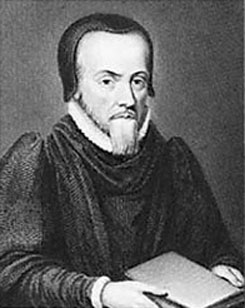
Today we remember Richard Hooker, who died on November 3, 1600. Hookrt is one of the great icons of Anglicanism, although that term was unknown to him, and certain Anglicanism whatever it means today, would be unrecognizable to him.
What established his reputation for later generations is The Laws of Ecclesiastical Polity. Bloggers occasionally like to run contests about books that everyone claims to have read but few people actually have; if there were such a context in the Anglican world, I’m sure The Laws would fare very well. It’s dense reading, in a prose style that is quite alien to modern sensitivities and I can’t imagine there are many people today with the stamina to make it all the way through all five books. Hooker was a man of immense learning and it shows throughout. He draws on patristic sources and on the scholastics, especially, Thomas Aquinas, in making his arguments.
Hooker is credited with originating the “three-legged stool” of Anglicanism, referring to the authority of scripture, tradition, and reason (actually he thinks of the latter more in terms of common sense). The image is not his own, and in his work, the three are not quite equal. Scripture is paramount. Hooker was a Protestant, after all. Reason is used to help elucidate scripture, especially when scripture seems unclear or contradictory. Tradition, too, is largely viewed as an interpreter of scripture.
Hooker’s pre-eminence in later Anglican tradition is largely due to historical developments. As conflict over theology and ecclesiology deepened in the seventeenth century, Hooker’s half-hearted defense of the episcopacy and his moderate Calvinism became weapons in the war against outright Puritanism. Having defended the Elizabethan Settlement, Hooker came to stand for the via media, even as the poles between which the via media balanced shifted dramatically.
 Preaching Grace on the Square
You must be logged in to post a comment.